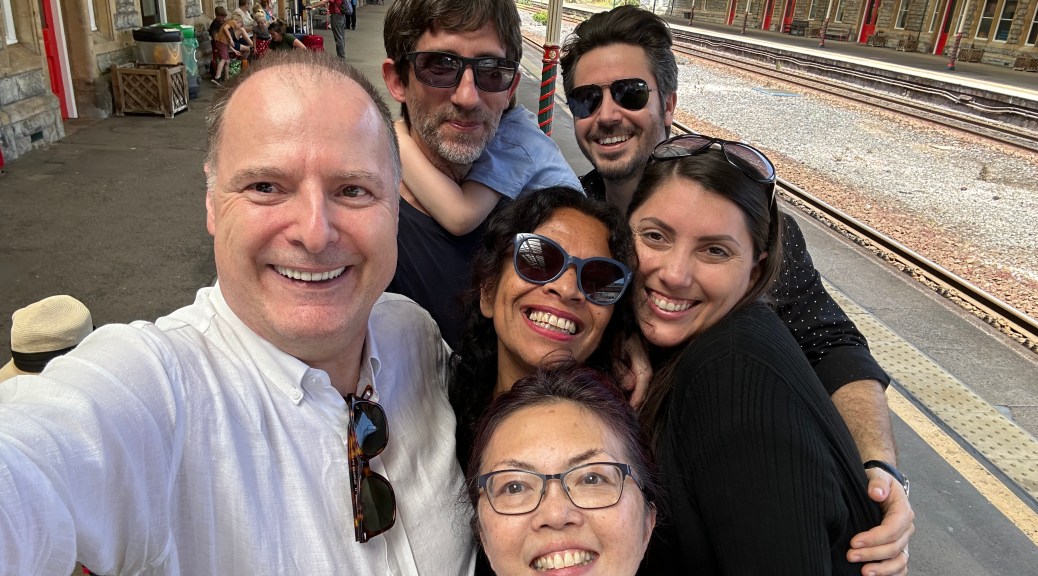
One of the resident teachers at the summer Feast was Mabel Rivero. I’d caught a glimpse of a private she was giving at Tango by the Sea late last year, coincidentally to another man learning to follow, and it looked amazing! So as soon as I saw she was teaching here too, I signed up for a private on the Sunday afternoon.
Fernando does have a photo from my lesson, which I’ll substitute when the poor man has a chance to catch up with messages, but for now Mabel is the super-smiley one in the centre as we waited for the train home …
Follower technique workshop
I don’t normally do group workshops, but as she was doing a follower technique one on the Saturday, it would have seemed silly to miss the opportunity. Signing up for this was indeed an excellent idea.
First because the workshop was fantastic! It won’t sound like much, I think, to describe what we did, but it made so much difference. Second, because there were only four of us in it, so it was like a semi-private.
She started by describing three points of contact in each foot: the little toe, the big toe, and the heel. She said that the neutral position for the standing leg is to split the weight between the three, with more on the big toe (ie. inside of the foot) than the little one (outside). Already, just by visualising that, I felt more stable on one foot.
Additionally, with the legs together, she said there may be up to four points of contact: heels, calves, knees, thighs. She said that how many we each had would depend on our anatomy (for me it was all four – thanks to cyclist’s calves!), but if we focused on maintaining all of them during a pivot, we would be more stable. There wasn’t too much time to practice this during the workshop, but it did seem to help – of which more in a moment.
We also worked on transferring weight from one foot to the other in smooth stages. This was familiar territory to me, having worked on it with Diego, but it made additional sense as a follower, since I don’t know what the leader will do next – complete the weight transfer or not.
That really whet my appetite for my private the next day!
Private
Mabel asked what I wanted to work on, and I took my usual approach with a new teacher: “Let’s just dance a song, and you tell me.” Given my baby follower status, I felt that the answer was likely to be ‘everything’ …
I’ve often said that being a tango teacher requires incredible skill on so many levels, one of which is mixing praise/encouragement with rigorous feedback. Different students may need a different balance, and the same student may need a somewhat different mix at different times. As a baby follower, I need more encouragement than as a leader, and she thankfully started with the good news!
The good news
She said I had a great embrace (Emma said the same, so clearly mirroring my leader embrace works!); that I was fully with her chest; and that I’m really listening to her lead. Given how utterly incompetent my following is at present, it was good to hear that something is right, but she said these are the foundations, so I was in a good place.
I’d said that my biggest challenge was being ready for the lead without either anticipating it, or feeling on edge. Diego’s ‘be slow and late’ advice helped, but I still needed more help here.
You’re never ‘waiting’
Mabel said there was one word she didn’t use for followers, and that was ‘waiting.’ She said that a follower is always active, and that if nothing is being led, you’re active in establishing and maintaining the four points of contact. Additionally, she wanted my free foot angled inward, inner side down, outer side somewhat up.
This really helped a lot. Diego had talked about having ‘magnetic ankles,’ and this was the left level up. There’s enough to be conscious of that it really did help me feel more grounded where I was, more in the present moment than worrying about the next one.
No lifting my heels to pivot!
I know, right? This was a revelation to me. I’d said one aspect of being on edge was not knowing whether or not the next lead would be a pivot; if so, I’d need my heels up to be ready, and she said no – no heel lifting. Instead, just transfer weight balance from rear to front of foot, to create just enough clearance for the pivot. This achieves two things.
First, because less movement is needed, it’s quicker. Second, it’s more stable. Again, this was a complete night-and-day difference!
When a teacher really opens my eyes to something, I almost want to end the lesson there, so that I can go play with it! But Mabel had much more to offer.
Bye-bye sternum, hello Y shape
She said I was good at following her chest, but not good at knowing whether I should be following a small movement or a large one. She said to think not just of the leader’s sternum, but rather a triangle starting there and going up to each shoulder. The opening of the shoulder would tell me the size of the movement required.
She then added something to the bottom of the triangle: a line between the leader’s sternum and belly-button, completing a Y pattern. To think of that, not knee bend, as the first signal of a change of level. The knee bend is a consequence, not the initiating action.
She said this is important because some followers have a mechanical approach to following changes of level. “Oh, the leader is going down, so I need to bend my knees.” She said viewing the bottom of the Y as the level indicator made it easier to follow organically.
Following the cross is easier than I think
It was clear when we danced that I wasn’t always sure when a cross was being led. She said that there was only one thing I needed to be aware of, and that was were we in two tracks or one? If two tracks became one, then I needed to do something to return to one track, and a cross was the easiest way to achieve that.
So don’t think about crossing specifically, just think about returning to a single track.
The two secrets to paradas
There was no let-up in the pace: we moved on to paradas. Mabel said my first job in following a parada was to feel for the leader’s heel. To position my foot against the heel, and begin the parada from there. In that way, there would automatically be calve-to-calf contact.
Her other input was, when I stepped over, to project, but not to actually step (ie. change weight) until that was specifically led. That gives the leader the option of reversing the movement.
Cunitas (rock steps)
How long is this lesson?! It felt like we’d covered about a day’s worth of material, yet somehow the hour wasn’t quite up yet, and Mabel wanted to give me an equally simple way to detect whether a leader was leading a cunita (rock step) or a full step (ie. did I need to be ready to return, or to complete the step?).
The secret here, she said, was level. If the leader stayed down, then it was going to be a rebound; if they began returning to the higher level, it was going to be a step. So I needed to stay down unless and until I felt the leader’s level rising.
I couldn’t believe the difference she’d made in one hour. The lesson also proved invaluable in developing my lead – but I’ll tell that story in The Feast blog post …
 ben lovejoy