The Feast is always a delight, but I’d originally thought it might need to serve as something of an antidote to the previous weekend’s London Tango Marathon. Amazingly – and despite floorcraft crimes deserving of 20 years to life – I had an absolutely dream time there, so I had two magical weekends, rather than one.
The trip got off to an interesting start with the train. The journey had everything: drama, pathos, comedy …
The train adventure
Things began at Paddington, when our train was reduced from nine carriages to five, and they cancelled all seat reservations. Fortunately, I have a longstanding and deep-rooted mistrust of train companies, so am always watching the departure board like a man with a longstanding and deep-rooted mistrust of train companies, ready to make a dash for it within milliseconds of the platform appearing. This is why Tina and I got seats, while many didn’t.
Next up, with several thousand people standing in the aisles, and exactly one minute before the train was due to depart, the train manager made a PA announcement that it would no longer be stopping at Reading. So those going there needed to fight their way off the train.
The train departed, and the recorded announcement said the next stop was Reading. I waited for the train manager to correct this, but no. Sure enough, the train stopped at Reading.
As even more people squeezed onto the train, there was a new PA that we would no longer be stopping at Newbury or Pewsey. So half the people who got on had to get off again, joined by some of those who boarded at Paddington.
The train departed Reading, and the train management made a PA announcement that skipping Reading had been a “white lie” to try to reduce crowding. We then stopped at Newbury, after which another PA announcement that this too had been a work of fiction. I’m hoping he’s working on a novel.
Victoria Hotel
Since the holiday park is full of holiday parkers in June, the summer edition is held at a hotel in Torquay. This makes it much more like Tango by the Sea (visit two), in that everything is in one building.
Last time, I stayed at a guesthouse about 10 minutes’ walk away. The room was huge, and the decor was lovely, but I’m pretty sure the couple who ran it were the inspiration for Fawlty Towers. This time I opted to stay in the main hotel – which proved to be kind of the opposite.
The bedrooms double as saunas; the walls are paper-thin; the air-conditioning vents in the ballroom are, I think, merely painted onto the walls … but the staff are the world’s friendliest! I’ve stayed in leading 5-star hotels which haven’t managed to match the service here.
The food was rather school dinner-like, but only in the sense of being unimaginative: think lasagne and crumble (not on the same plate). Filling, and tasty enough to fill the small gaps between dancing and sleeping.
The sunny weather also provided the perfect opportunity to get out and explore– I’m joking: I didn’t once set foot outside the hotel until it was time to go home.
Floorcraft, ah the floorcraft
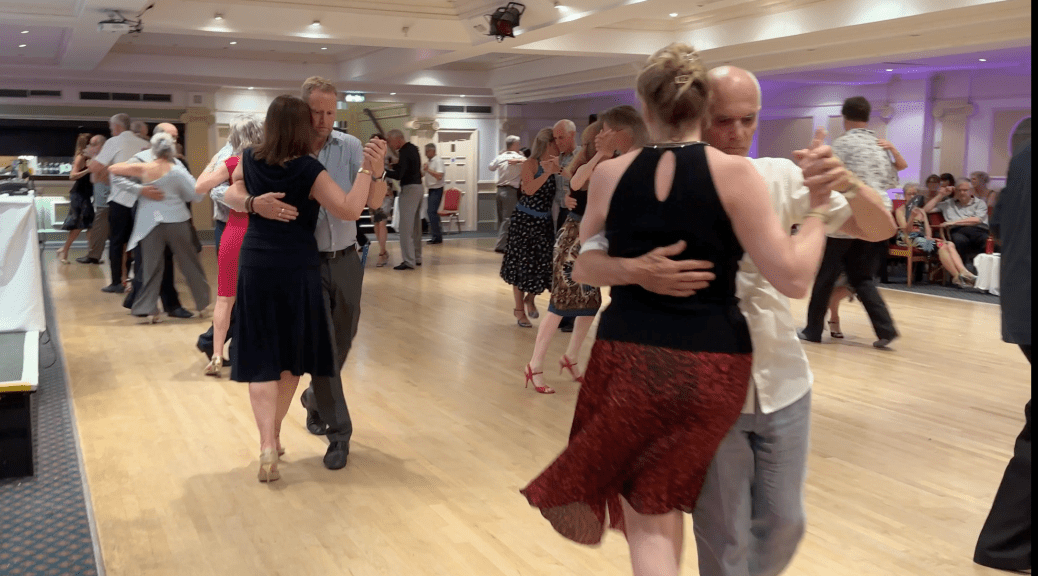
I know, I’m incapable of writing a blog post without mentioning the floorcraft, but it’s the difference between monitoring the couples either side for cues to advance, and doing so for incoming ballistic missile attacks. The Feast is almost BsAs-like in its floorcraft: everyone dances within their own space, and the line-of-dance is followed using compasses marked in radians.
As for leader cabeceo, it’s almost comically polite at times, leaders waiting for a smile and a nod even when the floor is almost entirely empty and I’m several miles away. It’s kind of the anti-London, where the preferred pista entry style for most leaders is sudden, backwards, and occupying the exact space you were in the middle of stepping into. If you waited for a nod in a typical London milonga you’d save on next week’s entry fee because you’d still be standing there.
Beautiful dancers
Regular readers will know that my ideal is to dance with a mix of familiar and unfamiliar followers. I of course love dancing with those with whom I already know I have a good connection, and whose dance I really enjoy. But for me there’s also something very special about dancing with someone for the first time.
Festivals seem to offer that perfect balance. There’s a virtuous circle; the more you do, the more people you know. But there are still enough unknown dancers to have, for me, the best of both worlds.
Plus, of course, I find myself dancing with, um, unfamiliar familiar followers. There was a woman from Chile who visits BsAs monthly (engage maximum jealously mode!) who said she thought she’d danced with me there in March. I naturally had no idea – until we danced, when I decided she was right. Admittedly being a silky-smooth follower there doesn’t exactly narrow things down, and nor does being a professor (I think half the country are – this is a place where Jung is everyday bus-stop conversation), but our dance did have a feeling of familiarity to it.
The quality of the dancing at The Feast is always wonderful – everyone is all about the connection, the music, and the ronda. It’s so luxurious to know I can cabeceo anyone in the room, and there’s a 99% chance we’re looking for fundamentally the same style of dance: close-embrace, calm, collaborative.
Preferences for the latter may vary in degree, from sufficient time to allow small emphases, all the way through to me leading little more than a direction, and otherwise following them – but it’s always a conversation.
There’s also a 99% chance that any follower you randomly cabeceo will be a truly beautiful dancer. As I said last month, the spirit of BsAs is very much alive in parts of the UK, and The Feast is definitely part of this.
I did have one very-much-not-random cabeceo. Mabel had invited me to cabeceo her in the evening milonga, saying that sometimes she could sit for a long time because leaders were too intimidated to cabeceo the teachers. I didn’t need to be told twice! She told me one song in our tanda was one of her favourites. Dancing with a teacher, to one of her favourite songs, while in front of the teachers’ table – no pressure, then! She did, of course, make it a delight.
The only dampener for me was a conversation over breakfast (or possibly dinner; my sense of time is somewhat vague at tango festivals), where some followers were talking about having done little dancing. I’d written only a couple of days earlier about the difference between theory and practice where role-balanced events are concerned, and it was sad to confirm that this applied to The Feast .
Rhythmical music and milongas
My relationship to rhythmic music continues to evolve.
I’d had an interesting chat with Ivan on WhatsApp about my Troilo tastes, and he pointed out that all the songs I’d given as examples had very strong rhythmical elements alongside the melodic ones – and he was absolutely right. That clarified for me that I’m not anti rhythmical music (I mean, we all like dancing to the beat some of the time), I just need it to be layered to consider the music to be headline act rather than supporting artist.
The Feast was the perfect playground to further explore this. In general, the afternoon milongas are more biased toward rhythmic tandas, while the evening ones are more melodic.
I was initially disappointed when I saw that Michael Cummings had been assigned a noon to 3pm slot, for a couple of reasons. First, that’s virtually dawn in my personal tango time-zone, and it seemed entirely uncertain I’d even be conscious then, let alone on the dance floor. Additionally, it meant that he was likely to be playing more rhythmic tandas than his usual much more layered music in the evenings. However …
I was awake and on the floor at noon; I have no idea how – probably some massive accounting error on the part of the time gods. The milonga was also very much rhythmic in nature.
But things have changed for me now. I mean, offer me a choice between a rhythmic and melodic tanda, and I’ll still take the latter, but … 90% of the time, not 100%. And where before there was a very substantial gap in the pleasure I got from each, now the gap is still present but notably smaller.
Perhaps it’s that listening to rhythmic music has paid off, or maybe the DJs here just make a point of playing mostly slower and silkier versions of even rhythmic songs, but somehow when dancing to them, it felt like I now had more time.
Tina shot a very brief video clip during this milonga, and I felt it really captured that sense I had of achieving that same smooth feeling in rhythmic dance as in lyrical.
Even milonga feels calmer now! That’s in part thanks to Mabel – which I’ll get to shortly – but also a continuation of a development which has been ongoing for a little while now.
Comedic cabeceos
As I noted last weekend, you can’t have a tango event without some comedy on the cabeceo front. This time, I managed a direct repeat of an experience at the London Tango Marathon.
Ivan and I thought we were cabeceoing the same follower at the same time. We each tried to defer to the other, while the followers (clue) looked from one of us to the other and back. Then as we each stepped forward, it turned out we were each cabeceoing a different follower, sat side by side!
Different festival, different leader, different followers, exact same script!
There was also a chacarera tanda. I now dive into these, albeit with vastly more enthusiasm than skill. When they announced it, a group of people stepped onto the floor rather randomly, with no sign of cabeceo, so I joined them – but then found the followers were already paired up. I looked around to cabeceo, found Tina had joined me, but another follower who saw me looking also approached me. I apologised to her, and made a point of cabeceoing her for the next tango tanda – which was a Romantica Milonguera one, and we had an absolutely amazing dance. I assured her she’d gotten the better deal …
Free bonus leading lesson
I’d booked a following private with Mabel Rivero, and also did her follower technique workshop. I had so much to say about her incredible teaching that I had to make that a completely separate blog post.
Although I’m new to trying to actually learn to follow, I did have a few following lessons very early in my tango journey. I wasn’t really attempting to follow then, but rather understand first-hand how my lead should feel. But now that my focus in these lessons has changed, I’m still seeing huge dividends for my lead.
Double-time has long been my nemesis, and while I have now reached the point of being able to reliably lead interrupted steps, and followers I trust to be honest tell me it feels fine, it has still felt somewhat rushed/awkward to me.
But Mabel accidentally fixed this. As soon as I started consciously thinking of maintaining a lower level during interrupted steps, they suddenly felt both smooth and effortless to me!
Additionally, thinking about the cross purely as switching from dual-track to shared track – and not specifically considering the mechanics of the cross at all – also turned out to be surprisingly thought-provoking when it came to my lead. To explain how, we need to take …
A brief philosophical diversion
Back in March, I recounted a story Luis had told me over lunch in BsAs:
Luis said he’d heaA group of five of the world’s most famous teachers decided, a long time ago, to create a more systematic approach to teaching tango, and they got together for a weekend to develop a pedagogy for the basic movements.
They started working through the basic-8, and got as far as the cross. All five of them had a different understanding of what lead was required. Not in the details, but on the fundamental question of: What exactly is it that leads a follower to cross?
They literally couldn’t find enough common ground to proceed, and that was the end of the weekend!
More broadly than this, there are (at least!) two seemingly-opposing philosophies when leading. One is: forget about what I do with my own body, and think only about what I want my follower to do with hers. Do whatever is needed to signal that.
Another is the exact opposite: focus only on moving my own body, and trust my partner to do what is necessary to move hers in order to remain in front of me.
As with many things in tango, neither is right or wrong, they are simply different approaches.
Experimenting with tracks, not crosses
In my case, I think I actually do a mix of the two, depending on the type of movement. With a cross, I’m definitely thinking about how I want the follower to move, and not so much about what I do with my own body.
But Mabel’s guidance on following the cross had me wonder what it would be like to take the same approach with my lead: think not about what I wanted my follower to do with her body (that is, not think specifically of inviting her to cross), but rather to have the invitation be to return to a single track, and let her choose the solution.
It’s really hard to put my finger on exactly how this changes my lead – and I don’t even know for sure that it does, from the follower’s perspective. But it feels very different to me. Somehow it feels lighter, smoother, gentler.
In the very limited time I’ve been thinking of it like this, followers have always crossed, as it is for sure the most obvious resolution – but I do feel like I’m offering a suggestion rather than making a demand.
So that was another joyful Feast
For the final milonga, I felt like I was back in BsAs: I had an early dinner, then set a wake-up alarm for 10pm and went to bed before making it onto the floor half an hour later.
Quite a few people left to get home the same day, so the final milonga was a more intimate affair. The time absolutely zipped by, feeling more like 10 minutes than three hours. The final tanda was an all-La Cumparsita multi-orchestra one, which I think is my favourite way to end a milonga. Tina and I somehow found the energy to stride a good 80% of it, on a suitably empty floor.
I got to sleep around 3am and woke at 7am. Thanks, seagulls and refuse trucks. I was one of a small group actually waiting for the breakfast room to open! This does not happen.
The hotel staff were at least two minutes late opening the room, and by that stage there was a dangerous mood among the hungry dancers. At one point, I was genuinely afraid that someone was going to tut. Fortunately, things didn’t come to that.
Many, many, many cups of tea later, we reached the train station to find that Fernando, Haris and Natasha had come to see us off. Ok, they’d come to see off Mabel, but that’s almost the same thing.

The train company made up for the earlier overcrowding by upgrading us to a private carriage.

Next up on the festival front is Cheltenham in August – see you there, I hope!
 ben lovejoy