It’s been a long wait to resume my following lessons! Diego is in Edinburgh, and Emma has been in BsAs, and I only managed this one before dashing off to Heathrow for a brief trip of my own.
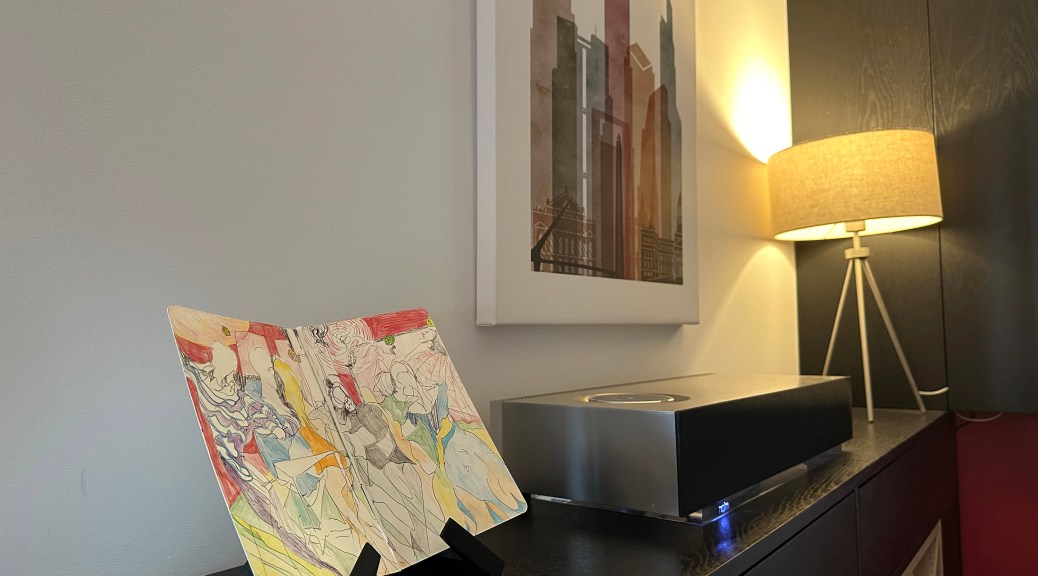
The wait was worth it, though. Not just for the lesson, but also because I finally got my hands on the sketch I’d fallen in love with when Emma posted it on Facebook! I will frame it, but it works pretty well on the temporary stand I’m using, and goes well with my BsAs print …
The circumstances weren’t entirely ideal for a private. There had been, um, non-tango-related issues that saw my stressometer dialled up to 11, and sauna-like temperatures the past few days had meant extremely broken sleep. Yet I somehow decided this was the perfect time to tackle my following nemesis: pivots.
Give me a kitchen island for support, and I’ll happily ocho away. But as soon as I try to do them without support, things are not pretty!
Add in the challenge of, you know, actually following a lead, and things got even messier. Diego might have suggested being late and slow, but he probably meant milliseconds rather than weeks, and as if dancing in water rather than treacle.
I did a little following at the Cheltenham festival, and found that anyone wanting to lead me in a pivot was best advised to send me a solicitor’s letter giving me 14 days to respond.
So the need to work on pivots was clear; the wisdom of choosing today to do so, not so much.
We ‘danced’ a song, and … yeah.
Pivoting in my own axis
Emma said that being able to pivot in my own axis would solve about 45 of my 50 problems (she may have put it more kindly than that), and she gave me an exercise which was as simple as it was effective:
- Take a side-step
- On completing it, ensure the hip of the free leg is fully relaxed
- Keeping the chest forward as much as possible, pivot 90 degrees
- Use the free foot for support as required
- Pivot back, and repeat in the opposite direction
Relaxing the free hip ensured I didn’t go past my axis in the outward direction, and keeping the free foot available as support if needed meant I didn’t lose my axis on the inward side.
Of course, doing this in an exercise is one thing, doing it while dancing is another, given that I don’t know ahead of time in which direction we’ll be moving. But it still made a huge difference.
The good news for an incompetent follower
Emma had more good news for me. If I ended up in an unstable position, then just do whatever I need to do to correct it. If I need to take a step, take it. If I need to change weight, do so. I’m used to just going with followers when they do something unexpected, and they would do the same for me.
Plus, I can make it part of the musical expression. A step might be forced by losing balance, but it can still be a musical one!
There were times when I wasn’t 100% sure what was being led. There was a time when Emma led a giro, for example, and I walked around her instead, but she said not to worry about it – I was still following her directional lead and timing, so it worked just fine.
In talking about it with Emma, it became clear I’m in an incredibly fortunate position here. I’m mostly going to be following women, and in 98% of cases they’re dual-role dancers. This means (a) they are usually highly experienced in the follower role, and (b) all about collaborative dance. The fact that my ‘collaboration’ might be failing to read their lead is effectively irrelevant: an experienced dancer sees it all as proposal and counter-proposal.
So yes, I want to get better at actually following the lead – and I will – but in the meantime, I don’t need to sweat it!
Open and closed embrace
Another challenge for me is that while the lead usually feels clear in close embrace, it feels vaguer to me in open embrace.
That may reflect my now very strong preference for sustained close embrace when leading, and even with a flexible embrace, opening only as much as is needed to create space for a pivot. With a very skilled follower, that may be a very minimal opening; I am not a very skilled follower …
So while I can follow steps and rebounds in close embrace, I do need space to pivot, and Emma said that the key here was ensuring I was actually fully following her lead for the embrace itself. When we were in close, and she slid her arm to open, I needed to match the degree of opening.
We worked for a while on me following in open embrace, and then reintroduced opening and closing.
Undeniable progress in an hour
This stuff takes time! I’m not going to become a follower overnight, and I need to expect it to be a gradual process.
But what is remarkable to me is that, every time I have a private, I can feel real progress. Ok, I might forget half of it next time – a good day in tango lessons is two steps forward, one step back – but I do feel just that little bit less incompetent each time.
I’m going to religiously do my new solo exercise, and then I think it might be time for a visit to Queer Tango London to practice – the one place guaranteed to welcome incompetent male followers!
 ben lovejoy