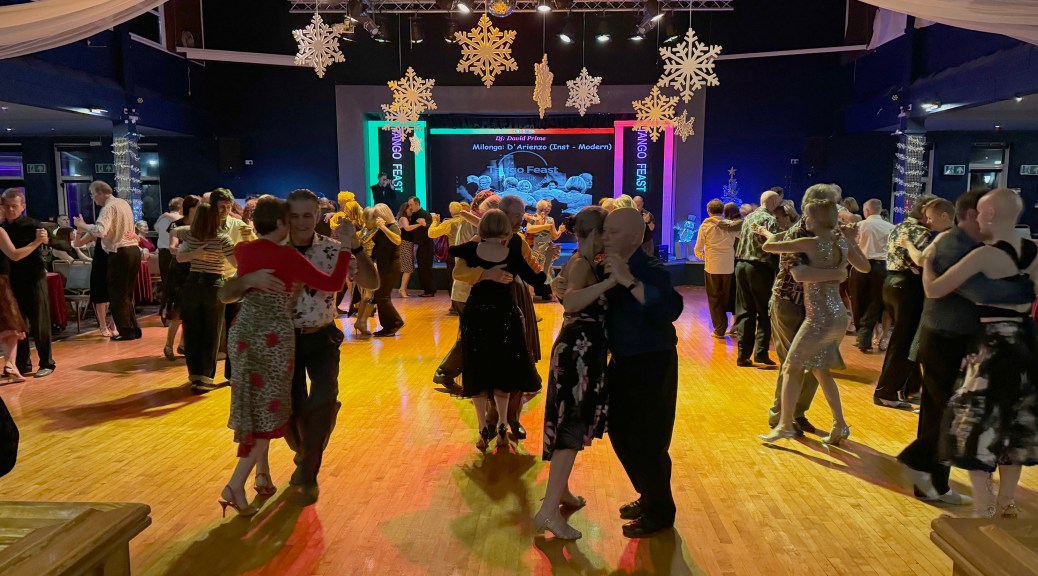
Last time my Feastward journey was cancelled by Storm Ciarán; this time by Aslef! But at least the latter gave notice, allowing me to rebook my train journey for the Wednesday evening.
I’d actually only danced once since the last Feast, at Tango Secrets. That’s been partly a lack of time, and an aversion to heading out into freezing temperatures – but mostly it’s because I’ve reached an all-or-nothing mindset with tango …
All or nothing
In one sense, it’s been a gradual process. From my early obsessive phase, which I think peaked at 11 events in one week, through increasing levels of selectivity. But the point I’ve reached more recently has been a step-change. These days, I want an event where I can have it all, or I’d just as soon not bother.
‘All’ for me equates to:
- Great DJ(s)
- Sustained close-embrace dancing
- Followers who are all about their partner and the music
- Collaborative dance*
- A high standard of floorcraft
*At least, as part of the mix. I can think of some truly wonderful followers who opt for a pure-follow approach, and do it so smoothly and beautifully that it doesn’t leave me wanting anything more. But having it all certainly includes a decent amount of collaborative dance with very active followers.
Of course, tango is tango, so disclaimers apply. A normally-reliable DJ can go off-piste. The partners we expect to be there may be absent. We may have the Cheltenham experience of the floorcraft being textbook in one milonga and indictable in another. And, of course, we may have a good or a bad tango day ourselves.
But if I don’t at least expect the above bullets to apply, then I’m not really interested.
The Feast always delivers. That’s of course in very large part to the amazing DJ line-up, mostly taken straight from my A-list. The only DJ I didn’t know this time was Jamie, and her spectacularly good set saw her immediately join the illustrious company of all my other favourites.
But it’s equally about the followers. I honestly can’t think of anywhere else outside of BsAs where the quality of the following is so consistently beautiful. (Except when I had a go! The steps and rebounds worked; for pivots, I’ll still need 14 days’ written notice, accompanied by detailed diagrams.)
The leaders, too, are almost always a pleasure to share the floor with. It’s virtually unknown for a couple to enter the floor without using leader cabeceo, and almost everyone is fully able to dance within the couple’s own space. It’s like the anti-London.
I will, though, have one brief rant: talking while dancing! Please don’t. You might not want to listen to the music, but the rest of us do. If you want to talk, there are plenty of places to do that. When I’m world dictator, there will be duct tape supplies next to the dance floor to be deployed in such circumstances. (I’ll forgive someone finishing the last couple of sentences as they start to dance, but there will be assistants with stop-watches.)
And don’t even get me started on the (thankfully singular) leader trying to teach his follower; with or without her consent wasn’t clear. To me, that’s especially unforgivable when Fernando and his team spends hours setting up a separate practice floor specifically for this!
And breathe …
Arrival & departure entertainment
I travelled down after work, so didn’t arrive until late, but fortunately a friend staying there picked up my key for me and turned on the heating, so I arrived to a cosy home-from-home.
The staff at the park are lovely, but their communication systems need a little work. I’d called them the previous day to let them know that a friend would be collecting the key as I might arrive after all the staff had left at 10pm. They duly took her name and assured me she’d be expected. This turned out not to be the case, and security wouldn’t give her the key. I phoned them back, and they said all was now sorted, and she was expected. Again, no! Finally Sam phoned me while she was with the security guy and he finally handed over the key!
I almost had an even more interesting time when leaving on the Monday. I’d arranged a 12 noon checkout, as I like to be able to catch up on sleep and then take a lunchtime train. At 11am, I was about to step into the shower when I heard the front door opening; things didn’t quite reach the point of the cleaning woman and I getting to know each other rather better than either of us would have wished, but I think I’ll put my suitcase in front of the door next time …
Both types of weather
Devon offered us both types of weather: raining, or about to rain. There were those who unkindly suggested that it never stopped raining, but I have proof that this isn’t true.
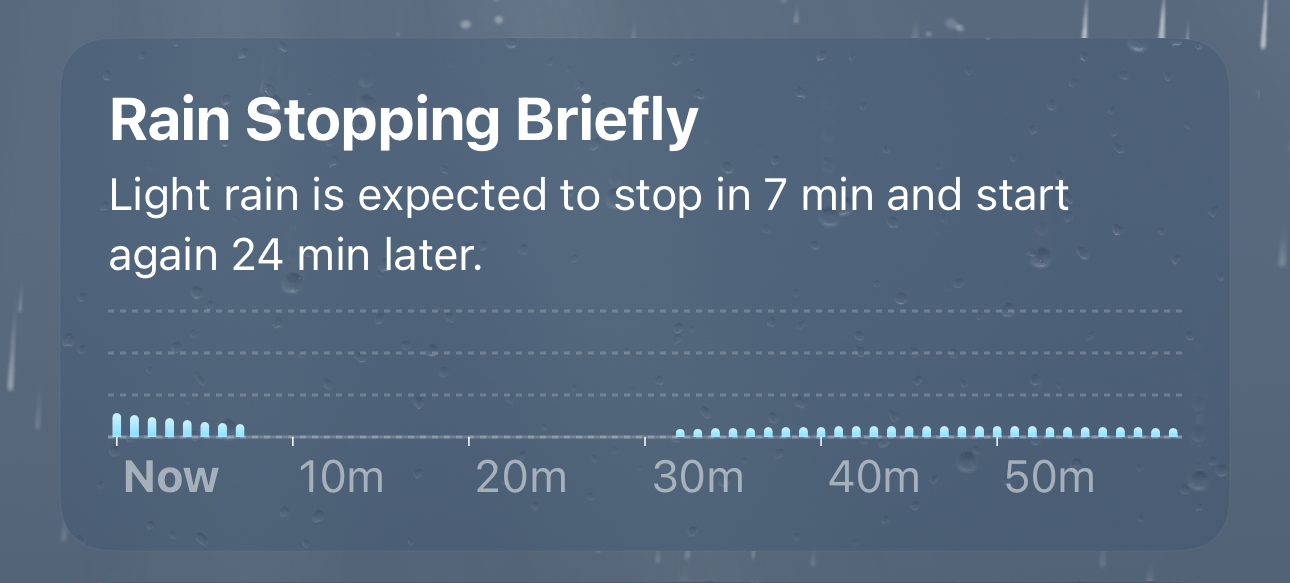
The journey home also provided evidence that it is sometimes sunny there – though the same photo also proved that the county isn’t very clear on the difference between a field and a lake.

Private with Mabel
Another benefit of arriving a day early was that I was able to book a private with Mabel before the first milonga. Previously, I’ve written a separate blog post on these, but this time the lesson was so fundamental to my experience of the Feast that I’m including it here. You’ll also have to bear with me while I delve into some essential context …
Back in the beginner classes days, we of course learn a bunch of figures. But because I began with privates, I was in the unusual position of having been introduced to technique before steps. So what I found in these classes was that my baby tango brain could either concentrate on the steps, and lose all technique, or focus on technique, and then forget the steps. Since I knew even then which was more important, my memory for figures pretty much ended at ochos, ocho cortado, giro, sanguchito, and classic cross.
Even if I could remember anything more, I could rarely dance any of it in milongas in that first year, because beginners are taught giant-sized figures for clarity, and I hadn’t yet learned how to shrink them enough for a milonga.
Eventually, I reached the point of being able to truly improvise on a step-by-step basis, so I then relaxed and happily consigned all the half-remembered sequences to history.
But …
There came a point where I wanted more variety and flexibility in my dance. Mostly I’d been working on achieving this not from new steps, but by introducing more varied dynamics into my dance. More mixing of smaller and larger movement. More blending of faster and slower movement. More acceleration and deceleration. By the time I arrived at the Feast this time, I would describe that as a reasonable work in progress.
But I did also feel like I needed more vocabulary, and the figure I wanted to begin with was the back cross. I’d been taught it at one point, but never really refined it or used it in milongas, so it was a rather dim and distant memory. There was also another issue: when I started dancing in the Argentine embrace, I’d kind of found I needed to relearn everything from scratch, because the movements need to be significantly adapted to the much more constrained space. The way I’d been taught the back cross way was opening the embrace fully, and then contracting it – and I definitely didn’t want to do that.
So, I thought, let me take a private with Mabel to work on re-learning the back cross in sustained close embrace.
We did. Successfully, according to Mabel – though as I still needed to very actively think about the various components, I felt I needed to practice it a fair bit before actually using it in a milonga. However, something surprising and exciting happened!
When leading it from a back ocho in particular, two things were key. First, the timing, in that the ocho needed to be interrupted before it could complete. But there was another, really crucial part: the change in the dynamic of the movement.
Mabel said that leaders always have to be conscious that some followers will default to completing an ocho. I’d experienced that myself when learning to lead a forward cross in cross system from a back ocho. Not to mention my beginner days, when I was able to lead ochos but struggled to lead an end to them!
So actually, the change in dynamic was every bit as important as the timing. It signalled to the follower ‘hold up, something is about to change here.’ Indeed, an argument could be made that the acceleration and deceleration is the most important element of the lead for a back cross.
And when Mabel led me, to demonstrate that point, a light switch flicked on in my head. Because the actual movement itself wasn’t so very different from an ocho. But her acceleration and deceleration meant that it was unmistakeable; there was no way in the world I could have received that lead and continued an ocho. The dynamic of the movement made it a night-and-day difference.
It suddenly became clear to me that the work I was doing on introducing more dynamic variety into my dance was far more fundamental than I’d realised up until that point. If I accelerated, or decelerated, or made the step smaller, or bigger, I’d thought it would feel to the follower like a pleasant enough variation – but no: it actually feels like a completely different type of movement.
So sure, I could (and may) work on increasing my vocabulary in terms of figures, but I can utterly transform my dance ‘just’ by these changes of dynamics. So that’s what I set out to do in my dancing at the Feast.

This was utterly transformational
Anyone who reads my blog knows that lyrical music is my first love. Pugliese, Troilo, the softer Di Sarli songs. And that I feel– no, felt far less able to express myself to strongly rhythmical music. The sharpness of Biagi was something I found especially challenging.
So when I tell you that I leapt out of my chair at almost every Biagi tanda, and that my gradually warming friendship with D’Arienzo completely blossomed, I think you’ll understand just how big a transformation this was. Suddenly I felt equal to the task of a really staccato piece. This was magical.
(I shall, however, continue to demand a proportional refund for any OTV tandas.)
I should hastily reassure Señor Pugliese that he remains my first love, and Troilo my best mate. The absolute highlights of the weekend for me were the (multiple!) Pugliese tandas with some space on the floor and an equally love-struck follower; those memories will last for a long time. But my days of resting during the Biagi and Laurenz tandas are very much at an end!
Even the fast little shimmies you get sometimes, that used to frustrate me because I’d hear them and mentally shrug with ‘Hey, I got nothing!’ But I found that I didn’t need to worry about what, exactly, I was leading – just do a shimmy! The follower might respond with fast steps, or she might just receive the sensation; either way, it worked.
So while, yes, while this is still a work in progress – as anything in tango always is – the difference was dramatic. It was clear from follower reactions that it wasn’t just me who felt this way. Added to the check-step lesson I had with Mabel last month, the value delivered in those two privates is incredible.
I even danced a few milonga tandas! My relationship status with milonga is best described as ‘complicated.’ I actually developed a love for it really early because it was simple, and a lot of leaders don’t dance it, so it was a great way for a beginner to get dances. But as things progressed, I started expecting more of myself – but couldn’t deliver at milonga speeds. Since then, I’ve gone back-and-forth on it several times.
These days I’m happy to be dragged out onto the floor from time to time, so long as my partner is clear that they shouldn’t expect more than say a dozen syncopated steps in the course of the tanda. Sam signed the necessary paperwork, and afterwards declared that she’d had fun, so I did risk it with a couple of other followers later. I still see it as my biggest tango challenge, but hey, if you’ll sign the disclaimer (and it’s not a D’Arienzo milonga, which is clearly an insane concept), feel free to cabeceo me.
The only downside was … I got less rest! On all four days, I danced like I was back in my obsessional ‘must dance every tanda’ phase. It was just so exciting to have this whole new playground! Usually at the end of the night, I’m buzzing so much from the adrenaline that I have to take an hour or two to wind down enough to be able to sleep, but this time I was so exhausted each night that, bam, I was unconscious within seconds of arriving back at my caravan.

The trouser incident
My dance did become a little more dynamic than intended during one tanda. In leading an accelerating entry to a sanguchito, I managed to catch the toe of my foot in the hem of my trousers. That saw me invent an entirely new tango figure, where there’s a sharp, mid-pivot pause, then the leader flails with their left leg out at an angle of 45 degrees in a desperate attempt not to fall over.
No followers or innocent bystanders were harmed in the invention of what I call el giro del dobladillo del pantalón. If you’re interested in learning this move, book a lesson with me, or just remove a few stitches from the hem of your trousers.
I didn’t immediately realise the cause of this little adventure, but a less spectacular repetition identified the issue. Sam kindly lent me a needle and thread, and I deployed my criminally bad sewing to affect a temporary repair.
Even this had a positive outcome, however. They were one of five pairs of tango trousers I’d bought in Buenos Aires back in 2019. The cut is great, and they work really well in terms of allowing any movement I’m capable of performing, but the quality is more Debenhams than Saville Row. I’d been meaning for ages to have some decent tango trousers made, but had never prioritised it – so this served as a prompt to do so! Watch this space.
Old and new friends – and cabeceo as an equal opportunity sport
I love to dance with a mix of familiar and new followers – though the more Feasts I come to, the fewer of the latter there are. And the sheer number of the former means that, even with my new mate Biagi, I still didn’t manage to dance with everyone I wanted to.
I did have a few followers say they were sorry we didn’t get the chance to dance, and I hadn’t been looking in their direction, so I think it’s worth reiterating my view that cabeceo is an equal opportunity sport. Here’s an excerpt from a blog post I wrote almost a year ago:
Arguably, in terms of how much time you spend on the dance floor, your cabeceo skills are even more important than your dance skills. In particular, a surprising number of followers seem to view it as a passive process – that cabeceo is mostly the domain of leaders. In my view, nothing could be further from the truth […]
Traditionally, the woman miradas, the man cabeceos. But in today’s world, it’s of course usually a much more fluid process, where there isn’t a clear line between mirada and cabeceo. It doesn’t matter who first looks or who first nods. The bottom line is, if you want to dance with someone, look at them. Oh, and a smile and enquiring expression when they do look your way helps a lot, whether you’re a man or a woman.
One thing I’d emphasis at the Feast in particular: roaming cabeceo is key. With the layered seating, and the crowds, it can be very hard to cabeceo across the floor (though it is very satisfying when it happens!). So if you have particular people on your hit-list who are sat across the room, then roaming cabeceo is the solution: take a stroll to a position in the room where you are within sensible cabeceo range.
Additionally, just the fact that you are standing rather than sitting (unless deeply engaged in conversation) is itself a signal that you are actively seeking to dance this tanda. Indeed, in the case of those DJs who are kind enough to project the upcoming tanda, that’s the one time when you can even cabeceo during the cortina. If you like to dance a particular orchestra with a particular partner, early cabeceo can be key!
Photos and videos
I usually shoot at least one or two pieces of short video, and just share them in the Facebook group. But a friend commented on how useful it is to see videos from the milongas and events I attended to get a sense of them, so here you go:
Additionally, I know how much most of us love photos of ourselves on the dance floor as memories of the great time we had, so I decided to add to the ranks of the photographers in a very small way! I’d tested out the new and improved Portrait Mode on the new iPhone 15, with mixed results, and I was curious how well it might cope in this situation.
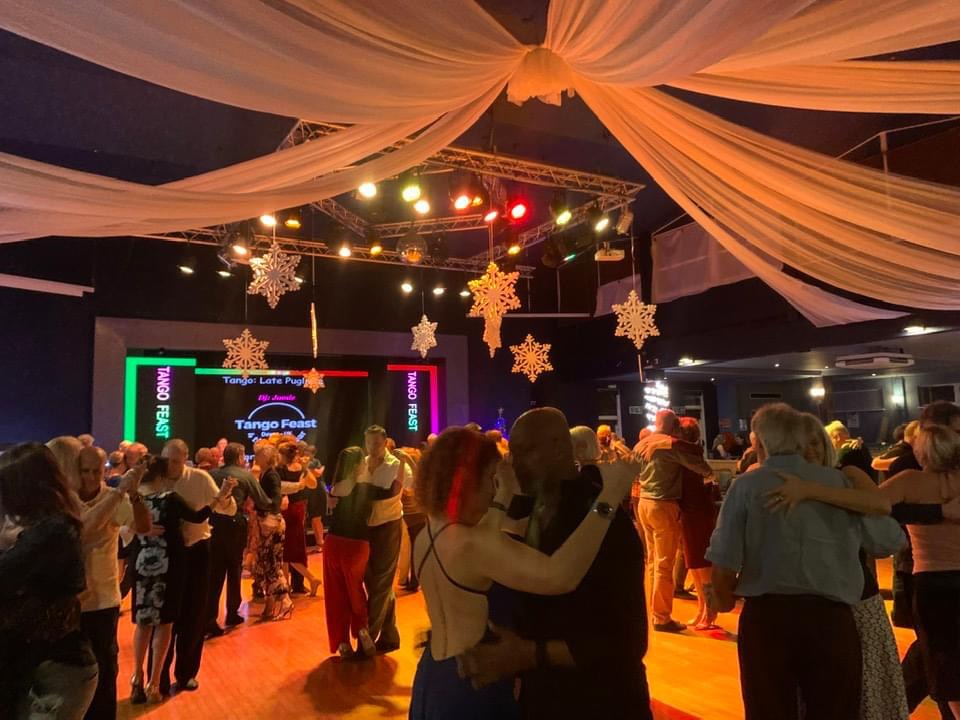
The answer is … variably. It worked for about one shot in three, but you can find the ones that did work here in the Feast Facebook group (minus one that the subject asked me to remove). This one of Mary and Chris seemed to sum up the atmosphere of the event rather well!

It did show that I’ll need to bring a dedicated camera if I want to take more, though. (Though I guess now my only opportunity will be some of the milonga tandas!)
Thank you all
A huge thank you to Fernando, Livy, and everyone else responsible for making the event happen; to all the amazing DJs; to the friendliest tango people in the world; and to the sublime followers who made the dance an absolute joy. The two Davids also get extra kudos – the Prime variety for setting up a perfect sound system, and the Thomas edition for xmas discounts on the three books I needed to add to 20 Tango Orchestras (you can find my review of the first of these here).

If the stars align, I’ll be in BsAs in March – but if they don’t, I’ll be in the next-best place for sure.
 ben lovejoy