David Thomas’s Getting to Know: 20 Tango Orchestras was one of the books that really helped me in my early days in tango. Having been all about the music from an early stage, it was great to have this guide to what to expect from each of the orchestras most frequently played at milongas.
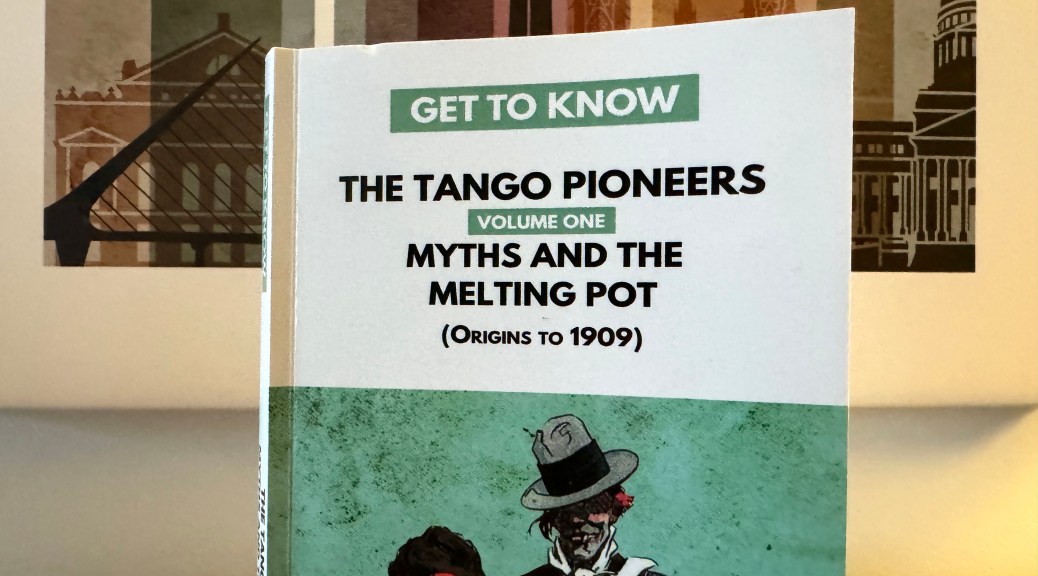
I’m no history buff, but it was David’s ability to bring historical info to life – and to give it relevance to dancing today – which persuaded me to treat myself to his Tango Pioneers trilogy. I read the first of these, Myths and the Melting Pot, in one sitting …
Tango has a great many origin stories: tales of how it began, and how it was in the early days. These are repeated so frequently that they are today generally regarded as simple fact.
Tango was first danced in brothels. Men started in backstreet lessons as followers, and were only allowed to proceed to leading – and then to dancing in milongas – when the established dancers deemed them worthy. Most early immigrants to Argentina were men, and tango was the only way to meet women. Tango was the first partner dance to be danced in close embrace. Tango was a working class dance, considered scandalous by respectable society. Tango was banned, by the Argentine government, and by the Pope.
David tackles each of these, and more, in the opening section of the book. Almost all of them are either provably false; lack any supporting evidence; or are based on misunderstandings.
In some cases, a myth originates in one text, which is cited by another, and another, and another, until it seems unassailable – all while disguising the fact that the whole historical construction is based on a single claim! And the claims themselves were often based on misunderstandings, untruths motivated by prejudice – or even misinterpreting satire as factual reporting.
The men as apprentice followers, for example. It is absolutely true that men danced with men, learning both roles. But this was nothing new, or unique to tango. There were men-only dance classes in Buenos Aires for many forms of dance before Argentine Tango, where men would go to become proficient at the dance before attending dance events. By definition in a single-sex class, they would learn both roles – but there is nothing special about tango in this respect. Nor does there appear to be any evidence of experienced dancers acting as ‘gatekeepers,’ telling newer dancers that they were only allowed to follow until competent at that, or men allowing other men to tell them when they were ready to start visiting milongas.

My favourite quote on this is in regard to this frequently-referenced photo: “We can only be grateful that the popular conclusion has not been that originally men danced with men in rivers.”
In the rest of the book, covering the time period up to 1909, David introduces us to some people whose names were completely unfamiliar to me – but whose work I turned out to know, in many cases.
More than a few of the tango songs known for their renditions by famous tango orchestras in the 1930s onwards were actually composed way earlier than this – and it’s fascinating to listen to those early, scratchy, hissy, thin recordings, and the familiar tango songs they became.
I say ‘listen to’ because this is one of the best features of David’s books. While I bought them in paper form, they are multimedia experiences thanks to David putting together accompanying audio and video on YouTube, with QR code links. So you can read a description of how a piece was written and first played, and the rendition we know today – then scan the code to listen to that transformation.
One revelation to me was that what we today think of as the defining instrument of tango – the bandoneón – was entirely absent in those early days. In an unlikely-sounding transformation, it in part replaced the role originally played by … the flute! Even the naming of the bandoneón is not, as is commonly thought, really based on the name of the inventor of the instrument.
I honestly expected to be most interested in the debunking of the myths (which was indeed the case), and then to skim-read most of the early history which followed. But I didn’t: I read it cover to cover in one day. I highly recommend it.
I’ve just started reading the second in the series. I’m not sure yet whether I’ll review each, or just update this review; watch this space.
 ben lovejoy