The fortnight leading up to the festival was among the most stressful and exhausting of my life. Short version: the place I thought was going to be my new home was withdrawn from the market on the day I made my formal offer for the pre-agreed amount; my plan B turned out to have hidden deal-breakers; and when I viewed my plan C, I discovered that the seller had decided to take the best offer by 5pm that day … and I got to view it at 4.43pm. And that’s skipping a whole lot of steps. What should have been a simple ‘Here’s my best and final offer, let me know’ deal on what became my preferred flat instead turned into some fast-and-furious negotiation, complete with an agent who went AWOL in the middle of it.
Suffice it to say that by the time the festival rolled around, if I hadn’t already been booked into it, I would happily have stayed home and spent the entire weekend sleeping. But I had a wonderful time last year, and suspected this would be the same. It was indeed, and turned out to be the perfect antidote …
Addressing the ‘mostly’ part first
Whenever there’s a mix of good and bad news, I tend to like to get the bad news out of the way first, so that I can focus mostly on the good. (This is a pattern which has gotten me into trouble in more than one relationship, but anyway …)
While the festival is in theory role-balanced, and registrations are accepted on that basis, it didn’t work out that way in practice. A lot of really wonderful followers told me they found it hard work to get dances.
This is nothing specific to this festival, of course. Indeed, I’ve previously written a post specifically about this issue. In that, I outlined my three theories about how this happens:
- Cheating by followers
- Cheating by organisers (definitely not the case here)
- Leaders who want to dance less than followers
But talking about it with a group of followers, they raised an additional issue:
- There’s no reliable way to identify the female leaders/dual-role dancers
Wearing flat shoes may be a clue, but I’ve noticed a growing number of followers who choose to wear flats, so it’s certainly no guarantee. One suggestion raised, which seems a no-brainer to me, is to have color-coded wristbands. Say red for leaders, green for followers, yellow for dual-role dancers. That would make it much easier to know who you can cabeceo. It would also significantly reduce the ‘cheating by followers’ problem, as their claimed role would be immediately obvious to organisers.
The other bad news – also not unique to this event – was the presence of a leader well-known for ‘problematic’ behaviour, who keeps turning up at different events. ‘Handy’ would be the polite description; ‘borderline or actual sexual assault’ the more direct one. Multiple followers warned each other about him.
I get that some of these things can be ‘he said/she said’ situations, but there comes a point where the sheer number of independent reports leaves no doubt. But organisers feel like they need evidence, and not every follower who has experienced it wants to report it, so here we are.
And breathe …
The music!
I feel somewhat guilty raising those issues, as the festival was otherwise a truly joyous experience for me – and that begins with the music.
Deya’s DJing on the Friday night was almost too good. Every time I tried to walk out of the room to get a cup of tea or have a chat, the next tanda would start and I’d find myself making a handbrake-turn to walk straight back in. The music felt well-balanced in terms of rhythmical and lyrical tandas, and somehow always seemed to be what I wanted to dance at that moment. The milonga tandas were my only chance to take a break – I think I quite literally danced every tango and vals tanda, up to and including the final one.
Same with Jessica Carleson on the Saturday afternoon. She was a new DJ to me, so I hadn’t known what to expect, but again it was just wave after wave of wonderful music, and I again danced almost all of the non-milonga tandas.
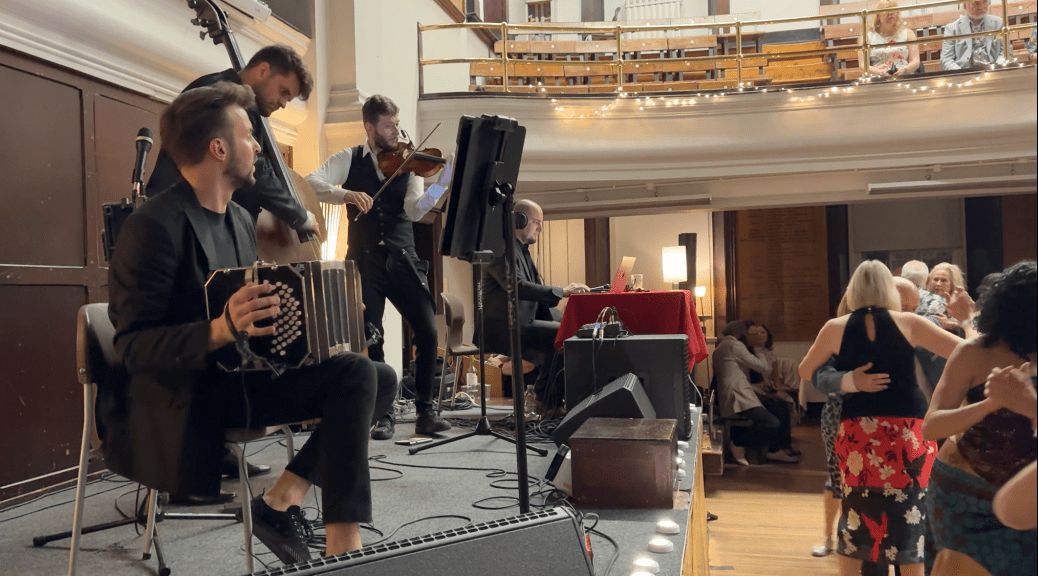
I didn’t get to experience much of Lucas Malec’s set on Saturday night, as I really needed some rest time by then! I timed my arrival for the start of the incredible live set by Bandenegro. I’ll be honest and say I’d checked them out on YouTube beforehand, and the arrangements were stylized to a greater degree than I like. But … dancing to them live … wow! It was just exhilarating. Plus they played some of my all-time favourite music. Oh, and in proper tandas! I’m glad to see this appears to be becoming the norm now with live orchestras, compared to past experiences of just unbroken play.
I looked somewhat worried when they announced they were going to play a tanda of original songs. But I had an absolutely sublime follower, so we looked at each other, shrugged, and nodded. I will say it’s probably hard to say what proportion of the experience is due to the music versus the follower, but it was a beautiful tanda.
Sunday began with good intentions. I got up. Showered, shaved, breakfasted. Even went outside into that weird daylight stuff. But the need for sleep arrived before the afternoon milonga did, so I went back to bed and slept right the way through it.
The Sunday evening DJ was also new to me: Anna Jorgensen. She also made it straight onto my favourite DJ list. Incredible – tanda after tanda of music I absolutely had to dance. I do often find the final milonga of a festival has a special feeling, and I’ll perhaps write about that phenomenon another time, but you can’t have that without music which rises to the occasion, and boy did it!
The followers
The UK festival circuit is a virtuous circle: the more events you attend, the more dancers you’ll get to know. There’s also a huge overlap between these and my favourite out-of-London milongas, like Tango Secrets and CamTango*. There were just so many followers whose dance I adore! It was definitely kid in a candy store on the plus side, and ‘too many wonderful partners, not enough time’ on the minus side.
*I don’t get to that one as much as I’d originally intended, partly because life, and partly there is a large roster of DJs and the standard is very variable. The quality of the dance there is always amazing, but if the music doesn’t appeal/the tandas don’t make sense to me, it’s not going to work for me.
I’ve said many times that I love a mix of dancing with familiar followers and new ones. In general, I’ve come to adopt an orchestra-based approach to this. For Pugliese, Troilo and Di Sarli, I will always look first for one of my favourite partners. There’s nothing worse than dancing to one of my favourite pieces and not feeling fully in synch with my follower. I remember one time (elsewhere) dancing a Pugliese tanda with a follower who was just a fraction behind, all the way through the tanda. I even tried cheating, leading slightly ahead so that we would complete a movement on time, but no – when she landed was random. To a very small degree, but enough to spoil it for me. I still remember that time!
If it’s an unfamiliar follower, my preferred approach is to begin with a vals, as that’s usually safe. My vals is very simple – even simpler than my tango. With some more intricate or layered vals, I may play a little in tiny ways, but only sensitive followers will respond to those, and no harm done if they don’t. Rhythmic tango similarly.
But there was one new-to-me follower where we’d talked while sharing a walk back to the hotel, so I knew a little of her background – a ballet dancer, and dual-role tango dancer. With her, I felt I could risk a Troilo tanda, and it was indeed delicious.
Of course, half the time I don’t know for sure whether I’m dancing with a new or known follower! On more than one occasion, I didn’t recognise the face, but did recognise either the embrace or the dance. It still amazes me how distinctive this can be. On more than one occasion, we reached the end of the first song and I was able to say confidently “I know we’ve danced before but you’ll have to tell me your name.”
A huge thank-you to everyone I danced with this weekend!
The Sigrid Van Tilbeurgh & Maria Filali performance
Anyone who knows me knows I am Mr Grumpy when it comes to performances. There are occasional exceptions, like Emma Reyes, but generally I’m just waiting impatiently for them to get off the floor so I can get back onto it. Either I’ll go get a cuppa and catch up on messages, or I’ll video them just to give me something to do.
But the performance by Sigrid Van Tilbeurgh & Maria Filali … wow! Just wow! I adored it. (An overly-ferocious door guard blocks part of it at the start, but I managed to break in after a few seconds …)
I sent the videos to a friend with a professional background in ballet and contemporary dance, and she asked me to explain why I loved this when most stage tango performances leave me cold.
I think part of it is the same reason Emma is an exception: there’s no attempt to pretend this is the same dance as social tango. That’s one of the problems with stage tango – it kind of makes this pretence of being the same dance, while being exaggerated enough to be visible at a distance, which results in some leaders wanting to emulate them, and I think that’s where a lot of floorcraft problems originate. Whereas this is unashamedly tango-inspired freeform dance.
Also, so many performances play up the drama, the seriousness, the fake-intense expressions. It’s just tired, and tiring. This performance, though, they are expressing the sheer joy of the dance together. They’re having fun – why wouldn’t they be?! – and aren’t afraid to show it.
In comparing notes, my friend asked me to talk her though how I saw their dance, so I used the third song (beginning at 6m 07s). Here’s what I wrote (stressing that this is simply my personal interpretation of the choreography):
The opening … one wanting the dance, the other unsure. Then it switches, and now the invitation is coming from the other dancer. Still hesitancy. The first dancer invites her again. Then this moment, this sense of ‘Ok, let’s try.’
It’s not decided who will lead. Then one of them offers and the other accepts. There’s an exploratory sense to it … is this how we dance together? … is this ok?
Then a moment of Yes! The smiles.
Next there’s a question: What happens next? Can I lead? Will you follow?
There’s a real change in the energy and style from the new leader. The follower responds: Ok! She leads in the same style, at the same pace. Until …
There’s no clear leader, no clear follower, just dance.
There’s a moment which requires tango exposure to appreciate. When it’s clear there’s going to be a volcada, absolutely no doubt, and then … it’s not! That sense of anticipation and waiting for the moment and then– no! Something else …
The section which follows continues to play like this – we think we know what’s about to happen, we think we can anticipate, but no …
Then we’re back into ‘Who’s leading? Neither, either …’
And the ending! So many performances end with this very clichéd ‘hand in the air’ pose, like they’re demanding applause at the drama of it. But this version feels like they are teasing that habit, making gentle fun of it by sliding into it so softly rather than ‘Padam!’
It’s beautiful, playful, joyous.
(For the avoidance of doubt, I didn’t watch any of the other performances at the festival, so there is no implied judgement about any of those.)
Feeling really at home in my own dance
I’ve written many times about finding my own dance; that’s of course one of the key challenges for each of us in tango – answering the questions ‘Who am I in tango? What is my dance?’
I think the first time I wrote about it in detail was just eight months in.
When people first talked about finding my own dance, I hadn’t the faintest idea what they were talking about. I mean, I was learning this new thing called tango. How could I have my own dance? I just wanted to know what the hell I was doing. But now I understand. At least, in part: I’m sure this too will be one of those things where there’s always a next level and a next level and a next level.
I was right: there are many levels to that. Collaborative dance changes everything, of course, because it’s no longer my dance, it’s our dance, and the nature of that changes with each follower. But the way I listen to my partners, and respond to them, is part of my dance. So yeah, it’s complicated!
As pre-amble to what I’m about to write, I should say that it’s not like I was previously spending much of my time being dissatisfied with my dance. I’ve been having a great time for a very long time with, I think, no more than the standard amount of tango angst.
But … I have always had a keen awareness of the technique issues on which I’m working, on the gap between where I am and where I next want to be. It’s not that this has in any way stopped me enjoying myself, but I was constantly giving myself reminders of issues identified in my privates – and, crucially, I was striving toward this idealised version of Good Tango Technique.
The thing is, when I watched dancers I admire, very often – in fact, most often – they are not exhibiting this idealised technique, and it’s clear they are not striving to. They have their own style, and they’ve decided for themselves which technique rules to respect and which to break.
I think I haven’t previously had the confidence to break rules. To say that, yes, I understand this particular technical element is considered ‘wrong’ but it works for me and my partners, and I’m going to do it anyway. One example of this is that many dancers whose milonga I enjoy watching will use quite vigorous left arm movements to express the music. I don’t go quite that far, but I’m no longer afraid to include some degree of musical expression in my left arm.
A non-tango friend with other dance experience watched a video of a birthday vals, and pointed to something in my posture which she liked, and which she wasn’t seeing in the leaders around me (it was a snowball tanda, so other dancers gradually filled the floor). The thing she identified (which I wasn’t conscious of doing) would be considered technically ‘wrong’ but is actually quite key to the way I listen to my partners, so I shall continue doing it.
Another follower commented on a type of movement I do which is unusual, and she really likes. That one wouldn’t be considered ‘wrong,’ but it’s also something I don’t think I’ve ever seen taught.
So I think I’ve reached a point of feeling the freedom to be fully me as a tango dancer. Not feel like I have to be better at following the technique rules before I can choose one or two to break. Not feel like I have to be some idealised standard of tanguero. Simply to be me.
Feeling right at home at the festival played a key role in solidifying that for me.
 ben lovejoy
A lovely write up about a deliciously lovely event, despite the ‘role balancing problem’. All the pros demonstrated the beauty, depth and individuality of tango, but I agree, Sunday’s performance was a tour de force. The first two dances where incredibly powerful, the third very emotional and the final one fun! I want to be able to dance like that!!
You wrote an incredibly perceptive paragraph about the role balencing, Ben. I went and read the previous blog you referred to! I was one of the many follows who did not dance as much as they would have ideally liked over the weekend. I did not get the opportunity to dance to the orchestra at all 🤷🏻♀️
I am learning the Lead role, I do not think it is ready for public use yet, altho in the Cambio I found myself dancing it. If dancing is the word. At the moment it is more a ‘there is a follow desperate to dance, I can give her that’. I hope in time it will become ‘a dance’ for me in that role too.
I am comforted that the organisers were very aware of the problem, and are already mindful of the need to address it.
I wish that many more Leads would be more situation aware. I have been in unbalenced events where I am aware they are dancing every tanda, exhausting!, but sometimes only two tracks out of 3 to allow a small respite. I felt that many Leads over the weekend did not ‘pull their weight’. For the community to work, everyone needs to invest.
I am not sure about either role being ‘easier’, as one of the comments suggests, but do not really have the experience to say. I feel that the demands in each role are probably equal but different. At the moment I find being a Lead exhausting: physicslly and mentally, but being a follow is largely a joy!
I hope your accomodation problems are resolved soon.x
LikeLike
Yes, it’s a really tricky one. We want to be supportive of dual-role dancing, while at the same time address the fact that it can lead to problems if people register as dual-role but in practice don’t dance about half the time in each role.
LikeLike
Hi there
I enjoyed your blog post about Sheffield Festival and completely agree with your comments about the performance by Maria and Sigrid.
The question of how to encompass the rise of dual role tango dancers and the fact that they are predominantly women and therefore skew the numbers is certainly something that needs working out within our wider tango community and I’m quite sure we will get there.
I do take issue with your comments about banning a particular dancer. I’m guessing we’re thinking about the same person. Among my female friendship group there are some who enjoy dancing with him, and some who don’t dance with him. In tango you can choose who to dance with, visually via the cabaceo or verbally. You can also select the tightness of the embrace by movement or verbally. Nobody has to dance with anyone who makes them feel awkward or uncomfortable for any reason. To ban someone because they move their hands seems like an over reaction and would mean this dual-role/follower-who-signs-up-for-events-as-follower would miss out on some of her favorite male led dances.
LikeLiked by 1 person
Thanks for commenting, Claire. It’s not because he “moves his hands,” but because he has done things like place the follower’s hand on his crotch. If I’d heard that sort of thing from one or two followers, perhaps it could be a misunderstanding, but I’ve now independently heard it from numerous followers. Indeed, when one person mentioned him (not by name) in a group conversation, all the women in that group knew who she was referring to. He is committing sexual assault, pure and simple, and while those who have suffered it once can avoid him again, that doesn’t protect those who haven’t yet. I know more than one organiser has spoken with him about it, but nothing has changed.
LikeLike
I’m disappointed that you think I let “anyone have a bash” at DJing, Ben. I don’t. But I do try to use as much available talent as I can. Come and try us again!
LikeLike
Thanks for letting me know, John. It was initially an assumption on my part that it was an inclusivity move, and when I asked a regular about it, they said that was “pretty much” the policy. I’ve now amended that section.
LikeLike