In tango, traspié refers to an interrupted step typically danced in milonga tandas – for which the literal definition is ‘to stumble.’
After six months off the dance floor, I got to enjoy one festival and six milongas before the return of symptoms suggested the surgical repair may have failed …
My previous surgery teaching me the 3Ps
My previous experience made me reasonably adept at navigating the NHS bureaucracy. In particular, the power of the 3Ps in reducing delays: proactive polite persistence!
My first example was when my surgeon told me my case was urgent, and that he’d be trying to schedule my op within four weeks. Those four weeks came and went, so I left a voicemail for his secretary asking whether she knew when a date would be set. I can’t say for sure, but I suspect it’s not coincidence that I got my surgery date a few days later.
Similarly with an uncomfortably leisurely follow-up appointment for one of the complications. I took the advice of a nurse and just turned up at the clinic two weeks before my appointment. They were able to give me the slot of the first no-show, reducing a fortnight’s wait to a few hours.
Applying them this time
Similar application of the three Ps seems to be working this time. For example, the first step was an ultrasound appointment a month away. I phoned the hospital to ask whether they had an earlier slot available and was told yes, reducing a four week wait to one week.
The ultrasound appared to confirm my suspicion, but an MRI was needed for a more detailed picture.
When I asked about activity in the meantime, my (new!) surgeon told me that, odd as it might sound, it would actually be helpful to apply no restrictions at all. Whether or not movement worsens the injury is actually a helpful diagnostic tool, and given my successful application of the 3Ps to ensure things are happening quickly, it won’t get dangerously worse within that timeframe.
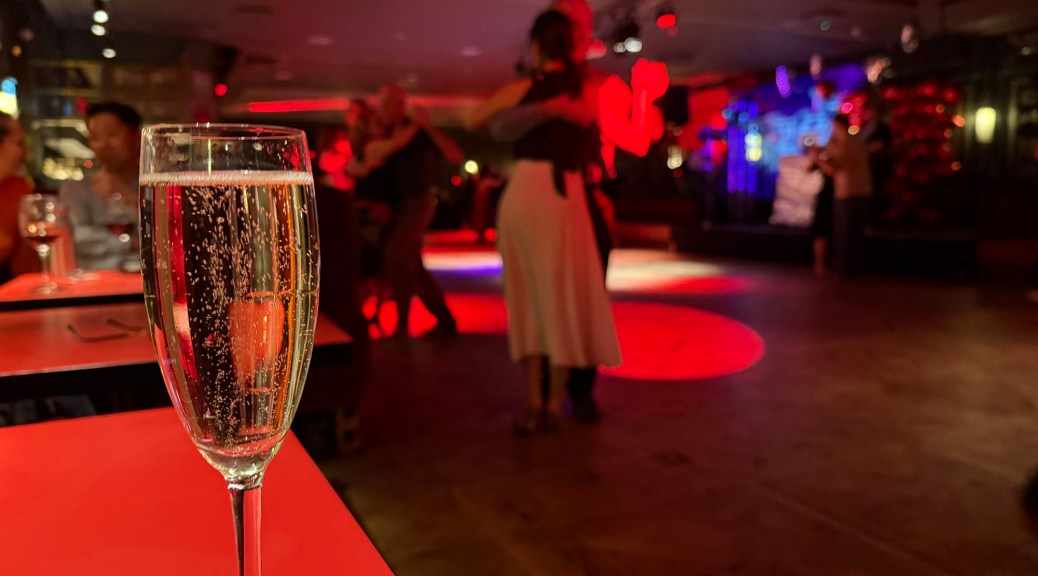
So, Re!
All of which led to me being back on the dance floor on Tuesday.
Although I very rarely dance in London these days, Re looked to be a big enough floor that London floorcraft probably wouldn’t prove fatal, and that did indeed turn out to be the case.
It was the first time I’d danced in a central London milonga for eight months, and the previous occasion was almost a year earlier.
Usually, the two most visible differences between central London milongas and anywhere else are (a) the lack of a ronda, and (b) open-embrace dancing.
Pleasingly, there was an outer ronda here, even if there were a few leaders doing the usual drunken zig-zagging from one side of the room to the other and/or dancing in place while everyone else was stuck behind them.
Even more surprisingly, a good percentage of the dancing was in close embrace. That was helped by the presence of a few followers I knew (if only when reminded) from UK festivals.
That aspect was admittedly a bit hit-and-miss when I cabeceod followers I hadn’t seen dancing*, which did drive home that I was still in London after all.
*Some consider that living dangerously, but watching a follower dance tells you a lot less than watching a leader, so I’m happy to do this.
Speaking of courage/foolhardiness, Tina proposed an intercambio tanda. Bearing in mind I hadn’t danced at all since New Year’s Eve, and my following lessons and practice stalled in May of last year, that seemed adventurous.
However, Tina’s been working hard on her leading and that really showed! We chose a milonga tanda because I perversely find those easiest when following. Despite the speed, the steps tend to be very simple, and most leaders are not crazy enough to try to lead me to pivot at milonga speeds.
It was quite amazing! My following hasn’t progressed at all, so all the credit has to go to Tina’s lead. I have no idea what it looked like (my eyes were firmly closed), but it felt really good, and there were remarkably few mis-steps.
I still haven’t figured out how to square that circle. When there’s a shortage of leaders, it feels selfish to follow and deprive the room of two leaders at once. Several female dual-role dancers have said not to worry about it, and maybe that is the answer – because the experience really did remind me how great it feels to follow when it works.
Next week’s Re is being DJ’d by Diego Doigneau, so I’ll risk another one – with the MRI the following day.
 ben lovejoy