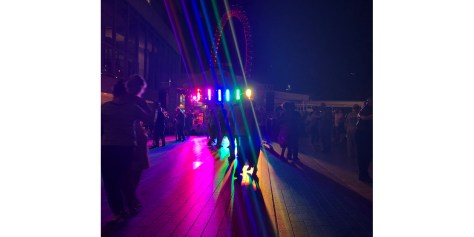
As with Spitalfields, I’d first seen Tango on the Thames long before I danced; stood and watched for a while, and thought of it as one of those delightfully eccentric English things done by people who aren’t me.
It was an incredibly hot day, 32C ambient, and more in the sun. We estimated when the sun would have dropped beneath the building line and turned up at around 7.15pm, which was perfect timing …
This year co-hosted with Queer Tango London, the atmosphere was very special. A large stage with a live band in the form of the Tango Terra Quartet: Kamila Bydlowska on violin, Juan Pablo Mauro on double bass, Tim Sharp on piano and Martin Espindola providing bandoneon, guitar and vocals.
Between their sets, we also had singer Corina Piati singing, with Sam Morris accompanying her on guitar.
When we arrived, Tango Terra Quartet was playing the kind of slow tango I adore, so I had to dive straight in the moment we arrived! Fortunately one of my fellow students from Olga’s musicality class cabeceod me almost the moment I’d put down my bag and hat.
There were so many people there, anyone could dance as much as they wanted to. Leader or follower, there was always going to be a keen partner in the crowds. It’s a good thing I’m no longer attempting the tanda-by-tanda accounts, as I couldn’t even count how many I danced tonight! I’m sitting here at home at 1am with very sore feet. Which I think is kind of a milestone of its own.
Speaking of feet, I’d invested in some dance sneakers for outdoor milongas: Rumpf Bee 1515. They have a thin sole, but with plastic bottoms that provide low-friction pivots; I quickly became a fan.
Tangasm one
I bumped into a follower from the Tango Space intermediate class with whom I’ve danced only a couple of times, but really loved it. There was a second milonga starting. I explained my ‘third song’ approach, and she said that was perfect as she had to hurry home after the very next song.
As it turned out, they were only playing two milongas, and next up was a slow tango. She asked if I would forgive her dancing only one song, and I assured her that was fine. We then had an absolutely amazing dance.
It was already a slow tango, and we’re both fans of slow dance, so I led it at half speed. She’s a very good dancer, so for my part I just loved the experience of dancing with her. But it feels like a win-win, because I can do a whole succession of the parada-and-pause thing, and she takes full advantage. I’m very confident she enjoys a leader who gives her full reign to do her thing.
We both thanked the other for a really lovely dance.
Accidental ganchos
One amusing thing happened in the course of the evening: I accidentally learned how to lead ganchos. Well, not exactly lead them, but have them consistently happen in one particular situation …
The circular ocho Diego taught me has become a stable of my dance. But because tonight’s music was slow, I paused in the pivot. To my surprise, my follower did a gancho.
If you imagine an ocho cortado, where I stop at the same point (left foot forward, right foot to the right), only instead of interrupting her pivot, I allow her to complete it, then bring her back in front of me. The point at which I was pausing was when she was pivoted alongside me, so there was then a gap between my legs. It was at this point that she kicked her left foot back between my legs and out again.
The same thing happened with a different follower. And again with a third. It took me a little time to realise that, yes, it was happening in the same way each time.
Now, I should say here I’ve never had a gancho lesson in my life. I have absolutely no idea what the lead is. It’s still possible that it’s just an obvious decoration to a follower if I pause in that particular position. But it’s equally possible that what I’m doing is, coincidentally, the lead for a gancho. Update: It appears not, so the ‘obvious decoration’ theory seems to apply.
There were two great things about that. One is that I think I can now figure out how to actively lead a gancho from that position, giving me a ‘free’ extra figure. The second is that it’s evidence of how quickly new things can open up once you reach a certain point.
It can sometimes feel like my progress in tango is painfully slow. I’m ten months in, and what I can actually do in a milonga is still– Well, perhaps with an experienced follower I can now say was still pretty limited. The giro is a game-changer.
But in terms of what I can lead someone of my own level, there is a part of me that thinks ‘Seriously? Ten months of hard work and that’s all you’ve got?’ I’m told I shouldn’t worry. Everything is connected to everything. Get one thing, and suddenly you’ve gotten half a dozen other things. And I believe it on an intellectual level, but that’s not the same as experiencing it.
Tonight, I experienced it twice. First, between the giro and counter-giro. Sure, my technique needs a tonne of work with either, but the point is absolutely proven that once you have one, the other is a trivial additional step. Second, that accidental gancho. No, it’s not the most useful of things to be able to do, but the very fact that I can accidentally discover I know how to do something is a very concrete demonstration of that ‘everything is connected to everything else’ principle. It makes it very much easier to believe that the pace of learning accelerates.
Tangasm two
I’d been struggling with the giro, but here had an experience of an active follower just turning me around at high speed.
Fede and Julia had said that once I had the normal giro, then a counter-giro was an easy transition. They were absolutely right. Not that I have a giro in the sense they meant – of decent technique – but once you have the feeling, then it’s not really any different in either direction. Just keep opening and try to match steps with your follower.
I’m not under any illusions: my current state of play with the giro is that I can lead it, clockwise or anti-clockwise, with a really good follower who can do a giro in her sleep. It will still take some significant work before I can lead it with dancers of my own level. But that is still massively beyond where I was. That’s where I wanted to get from today’s lesson, and I got much further than expected – with a counter-giro too of the same level!
So I couldn’t be happier right now! Yep, I’m aware of the limitations of my giro, both in terms of the level of follower needed to make it work, and my many, many, many technique challenges. But … with some followers, I have a giro and a counter-giro that works. And works at high speed! That’s huge.
I’m splitting the credit for this multiple ways. Me for deciding on a change of focus: get the feeling first, sort the technique afterwards. Julia and Fede for rolling with that (harder for Fede than Julia, I think!) and giving me what I needed from the lesson. Me for going for it in the milonga.
Today was officially a very good day!
 ben lovejoy
6 thoughts on “Tango on the Thames tangasms, with giros and counter-giros – and accidental ganchos”