Business travel back in my tech research days contributed to me notching up a total of 87 countries, so it isn’t that often I get to add a new one to the list, but Latvia made #88.
Tango Wagner House was a new encuentro in a new city in a new country, but it all felt wonderfully familiar …
Pre-event stress
The logistics didn’t get off to the best of starts. Probably for this reason, British Airways cancelled both my outgoing and return flights and rebooked me on indirect Finnair ones, including a rather tight outbound connection in Helsinki – and not just one but two 5am starts!
To add to the fun, I had some passport-related entertainment. Thanks to careful choice of grandfather, I’m fortunate enough to have an Irish passport as well as a UK one. Ireland is almost unique in offering a credit-card sized passport card in addition to the book. Unlike EU ID cards, the Irish Passport Card is a full, legal passport and obviously more convenient than the passport book. It remains valid for UK entry after the new rules were introduced. Finnair check-in appeared unaware of this, however, and it was only when the BA check-in person next to them leaned over to tell them it was fine and showed them which button to press that I was finally checked-in.
Since I had exactly the same experience on the return journey, with staff at both Riga and Helsinki doubting the thing they were holding in their hand, I’ve reluctantly concluded that the card is now more trouble that it’s worth. UK passport officials did confirm it’s valid for entry, but also weren’t surprised that nobody knows it – they suggested carrying the Irish passport book in future (which still beats a UK one, as you can use it for EU lanes outbound and UK ones when returning).
Additionally, I was due to sell and buy a flat immediately after returning to the UK, and an issue that was supposed to have been resolved before my departure wasn’t – so stress levels were relatively high!
And breathe …
Riga
I was staying in one of the recommended hotels on the edge of the Old Town, so just a nine-minute walk to the venue. That walk was, however, along cobbled streets and slanted pavements that left me in constant fear of twisting an ankle before I could reach the dance floor!
There was a walking tour of the city included in the package, which I had no plans to do: my complete planned itinerary for the visit was ‘dance and sleep’ (with rather more of the former than the latter). However, it was such a beautiful town that I changed my mind. It was a really interesting tour, ending with a 20-minute organ recital – of which I very much enjoyed two-thirds. Louis Vierne, your Carillons de Westminster may be an ode to my home town, but you and I are never going to be friends.
The video tour includes the first minute of the organ recital: Toccata and Fugue in D minor – Bach is definitely my friend!
The venue
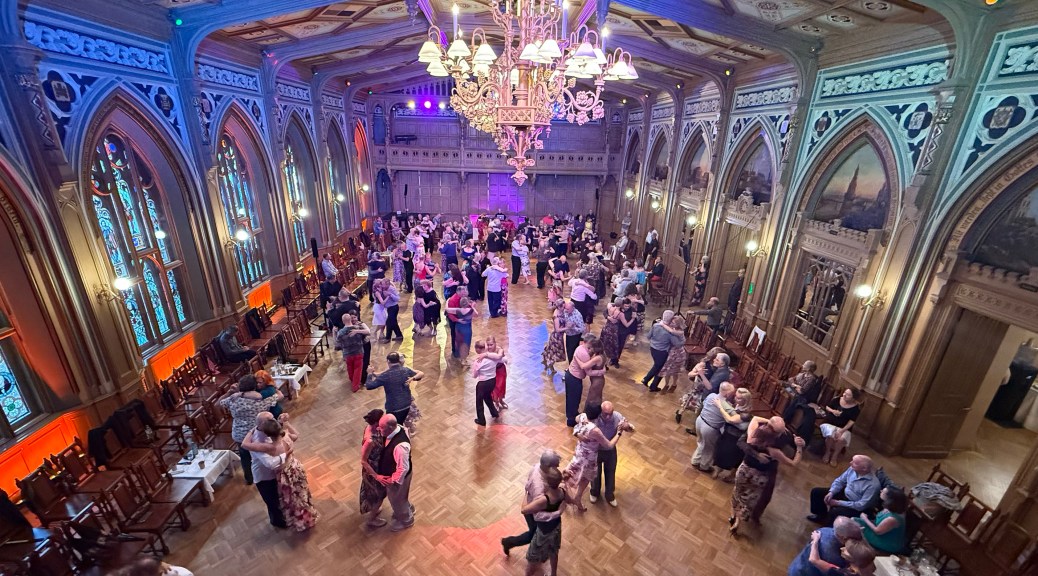
The event is named after the venue in which it’s normally held. Incredibly, the absolutely magnificent venue you see in the photo above – Mazā Ģilde, or the Small Guild – is merely the alternate while Wagner House is refurbished!
The floor started out a little slippery, but was otherwise perfect. Sometimes very high ceilings can be challenging for sound systems, but the setup here was truly excellent, with even sound throughout.
A roomful of strangers … but not for long
I’ve said that The Feast feels like walking into a room full of friends, and it’s quite a contrast when you don’t know anyone in the room. Especially at an encuentro – when I can feel like the tango baby, as many people have been dancing for decades – it can feel a little intimidating.
However, a teacher I trust to be honest had assured me I’d fit right in, and I’ve learned from experience that the solution to nervousness is always to dive in immediately and start dancing.
Three factors assisted me in this. First, the Thursday evening was actually a public milonga ahead of the official event, comprising a mix of encuentro participants and locals. Second, it wasn’t quite true that I didn’t know anyone, so I was able to dance the first two tandas with Felicia and Sheila, which helped ease me in (thank you both!). It later transpired that I’d also danced before with a couple of other followers, one in BsAs and the other at The New Tango Light. Third, it was a very friendly atmosphere.
It took a surprisingly short time to start to feel at ease there, and not too much longer before I was feeling at home.
Speaking of which, I usually arrive before the start of a milonga, and one reason is that I tend to be a little fussy about my seating position. I have my water bottle, travel mug for tea and my fan. It’s useful to have a table to put these things, and there are usually a limited number of seats next to one. I also try to position myself with the best possible sight lines for cabeceo. For that reason I like to be there in time to have my choice of seat – for previously discussed values of seat claims.
Where there are more than enough seats for everyone, it seems reasonable to say that a chair is nominally reserved if you habitually sit in it during an individual milonga, have draped some clothing or shoe-bag around it and have your shoes beneath it. This doesn’t constitute ownership. Anyone can sit there when you’re not using it, whether that’s to come chat with people on that table or simply try a different position in the room. If your habitual chair is occupied, you just sit somewhere else until it’s free again. The only breach of etiquette in my view would be to try to claim it as your own and position yourself there permanently when someone has clearly already done that.
(As I also said then: this is me, so don’t pretend you’re surprised that I’ve thought – and written – about chair etiquette.)
But the other big reason is that I adore walking, and usually the first tanda provides room for a big one on a clear floor. Here, however, the opportunity was very limited. At least half the participants were there from the first second of each milonga, so the chance for a big walk was generally limited to the first 30 seconds to a minute!
Cabeceo across the width of the floor is always more challenging when you don’t know people, as it’s less clear who is being targeted. I later ended up with the opposite problem, of enjoying dancing with several followers sitting close together – this always involved a great deal of mime and laughter.
It’s of course lovely to walk into a room where you already know everyone, but there’s also something very special about the transformation from knowing almost no-one to feeling like I’ve found a new tango home. That gradual unfolding is a very beautiful thing to me.
I also loved the international mix. We definitely had all the Scandinavian nations represented, almost the entirety of Europe too, and a sprinkling of dancers from further afield. Finally, I think about a third of those I danced with on the opening evening were from Riga, many of them staying for the full weekend.
The DJ line-up
The DJ line-up comprised:
- Thursday: Zinta Flores (Latvia)
- Friday afternoon: Max Marzano (Italy)
- Friday evening: Jack Rombauts (Belgium)
- Saturday afternoon: Guntis Smats (Latvia)
- Saturday evening: Maria Teresa Piazzolla (Italy)
- Sunday: Mariella Lazzaro (Italy)
I didn’t know any of them beforehand, but I certainly hope to do so in future! Wow. Also: wow.
I’m usually a little cautious about praising DJs in blog posts because I don’t want any omissions to be conspicuous. But here there were no such concerns – every single DJ was in the great to amazing range. I really could not have been happier with the music – an opinion which appeared near universally shared.
There were so many times I’d decided to rest during the next tanda, only to be immediately pulled back out of my seat by the music.
I try to shoot one video clip for each milonga, and you may be surprised that I was filming rather than dancing when you hear some of the music. But at this event my feet literally couldn’t dance every single tanda whose music inspired me.
Oh, and did I mention ‘wow’?
The followers
Also wow. Words are always a very inadequate way to describe delicious following, and that’s certainly the case here.
One key indicator of a great follower is when I can lead the most subtle of movements and feel them respond precisely. That’s partly a practical matter – on a very packed floor, subtle movements may at times be the only option. But I also adore the dynamic range, from tiny movements for the quietest moments in the music to big steps to the most dramatic ones. Finding that range in my own dance took quite some time, and while that was partly about developing my lead, it was at least in equal part the delight of discovering just how tiny a lead skilled followers hear. And in this room, anything I could lead, almost every partner would follow.
Subtle following also shows up in things like acceleration and deceleration. All followers will respond when it’s of a certain magnitude, but the ability to lead a very slight change in speed during a movement and feel the follower match it exactly, is something really special.
Adjacent to that, but not quite identical, is when you feel the follower respond to a texture rather than just to the movement itself. That too is virtually impossible to describe. I mean, you can of course talk about things like a sharper or smoother movement, and perhaps words like dragging, stretched, compressed … but mostly there aren’t the words to capture a shared sensation.
Then there are suspensions. I’ve always loved the pause, but over time I’ve got to understand the infinite variations that are possible. That a pause is almost never a complete stop, even when it appears so from the outside. From within the embrace, there is almost always some tiny hint of the movement that came before and the one that will follow. Sometimes it feels like it would be measured in tiny fractions of a millimetre, but to have that sense, and to feel it shared by the follower, is one of the most delicious of feelings.
One thing that really adds dynamism is to lead a fast movement into a staccato stop. There’s the briefest of decelerations in the way I lead this, but it takes a good follower to respond to this. Here, literally every follower did.
All of this is part of the essence of tango to me, that secret world within the embrace. An outside observer can see some elements of the dance, of course, though they can’t necessarily judge how those would feel – but so much of the dance is completely invisible to the outside world, and I think that’s one core element of the magic.
Then there’s collaborative dance. There are moments in tango when you rethink something, and that was the case for me when it comes to the language we use for following. It’s common to use terms along the lines of:
- ‘Pure’ following, and
- Active following – or collaborative dance
The thing is, this weekend really brought home how there’s really no such thing as a ‘pure follow.’ It’s instead a spectrum, and all the subtle communication I reference above very much works in both directions. The issue I now have with the language is that all skilled following is both active and collaborative.
A follower might choose to leave the movement decisions to the leader, but still contribute their own texture to each movement depending on some mix of how they feel the lead and how they hear the music. We don’t typically describe that as active, but it absolutely is.
Another follower might mostly follow exactly, but every now and then use their own body to draw the leader’s attention to some element in this music they enjoy. I will always default to dancing to the singer, but a follower might signal a ‘hey, shall we dance the violins here?’ It’s all active, and it’s all collaborative.
Many followers were collaborative in the usual sense of the term, and what was common here was to find a way to simultaneously follow my lead while also expressing another instrument. I know it’s possible to lead one thing for my follower while dancing something else myself, but I can only think of one specific case where I achieve this. 98% of the occasions it happened this weekend, it was entirely down to the follower.
Which is another reason I think we need a more specific term than collaborative. Any dance is collaborative. The composer, orchestra and dancers are all creating something together. What term we use instead, I don’t know, but I think it’s worth some thought.
So yeah – the followers here were so good they made me rethink the language I use to describe different approaches to following.
The floorcraft
I have, on rare occasion, been known to comment briefly and in passing on the topic of floorcraft. That’s because, to me, it’s the difference between being able to express the music in cooperation with my partner and the couples around me – and having to serve more as bodyguard than dancer.
The floorcraft here was almost entirely exemplary. It really felt like being back in BsAs. To have a crowded floor with perfectly-spaced couples in distinct rondas, and to know I can trust the couple ahead, behind, and to the side, was just an absolute joy. It was the anti-London.
Leader cabeceo to enter the floor. Couples dancing within their own space. Safe movements. An advancing ronda. The floor was truly a thing of beauty.
I also noticed a lot of leaders using diagonal dance. This was a revelation to me when I discovered it during my first visit to BsAs back in 2019, and while I aim to use it most of the time, it works best when the leaders alongside me are doing it too – and that was often the case here.
I usually just link to previous posts, but in this case it was from a lengthy post while in BsAs so I’ll embed here the relevant excerpt:
I’d read that milongueros dance diagonally, facing out of the ronda. So instead of facing directly forward in the line of dance, they are facing 45 degrees to the right of it. Think of it like a diagonal parking space.
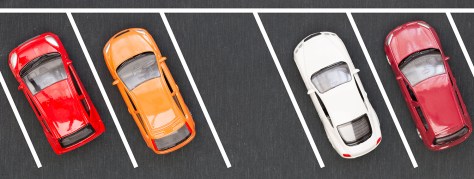
This provides four benefits:
- It’s a very efficient use of space (you can fit five cars in the above space, versus 2.5 end-to-end)
- If others around you do it, you each have space to move forwards and backwards
- You have a perfect view of when the ronda moves
- Your follower is protected from both the couple behind you and those in the inner ronda, because if either steps into your space, they are going to hit you, not her
It suddenly clicked. When the ronda moves, you can turn to walk forward, but the rest of the time you have your little reserved space.
I did have to use that slight rider when I praised the ronda, as there was one rather odd exception: the Friday night.
No matter how selective organisers may be, they can never guarantee that every leader will be well-behaved in every tanda. And what I got to see very clearly is the impact that a single selfish leader can have on an entire ronda when the floor is at its most packed, thanks to the knock-on effect.
There were two blindingly obvious rondas, but a single leader was zig-zagging between them. Each time he zigged, the leaders in one ronda would have to take evasive action; each time he zagged, the same was true of the other ronda. Others would then have to evade them, and so on, and so on. No exaggeration: I literally saw one solitary leader causing two well-ordered rondas to turn into chaos.
The thing is, it never seemed to recover. That seems to be the norm when this happens – you’d logically expect the next tanda to serve as a reset, but for some reason that doesn’t generally happen, and here there was a significant degree of Brownian motion for the rest of the night. I actually decided to stop dancing as a result – and I never stop dancing before the end of a milonga! The dancing had been so beautiful I couldn’t bear to compromise it in this way.
Fortunately, all was well the following afternoon – and for the rest of the event. I’m assuming the organisers had the offender taken out and shot, their body buried in the conveniently adjacent churchyard.
The food
My hotel included breakfast, and on the first morning I ordered room service for the latest possible time-slot. When it arrived, there appeared to have been some mix-up with my order, as they apparently thought I was a family of 12. Latvia is a pretty small country, and the omelette alone covered much of it.
I didn’t order it again – especially as the encuentro came equipped each day with enough food to feed most of Riga. It was the best spread I’ve ever seen at any milonga everywhere, and was very much appreciated!
The bow ties
One of my ten bow ties turned out to have a quality issue, so I returned it for a refund a few weeks ago. That obviously meant I had to buy a new one to replace it, and just as I was placing my order, another four accidentally fell into my shopping basket. That gave me a total of 14.
My dressing time is now:
- Dressing: 5 mins
- Tying and fine-tuning bow tie: 5 mins
- Between the two, deciding which bow tie to wear: 45 mins
A good 50% of followers expressed their admiration for them. Why did no-one tell me about the bow tie effect when I was younger?
I did discover one drawback, however – when I was standing at the tea station and somebody turned to me and asked me to replenish the orange juice … (He did apologise, about a dozen times.)
Sleep? Who needs sleep
Tell me you’ve been at a tango weekend without telling me you’ve been at a tango weekend.
In part due to that 5am start on the way home. My plan had been to leave the milonga at 8pm, say my goodbyes and be in bed by 8.30pm. However, three friends had other ideas, involving goulash and wine, so …

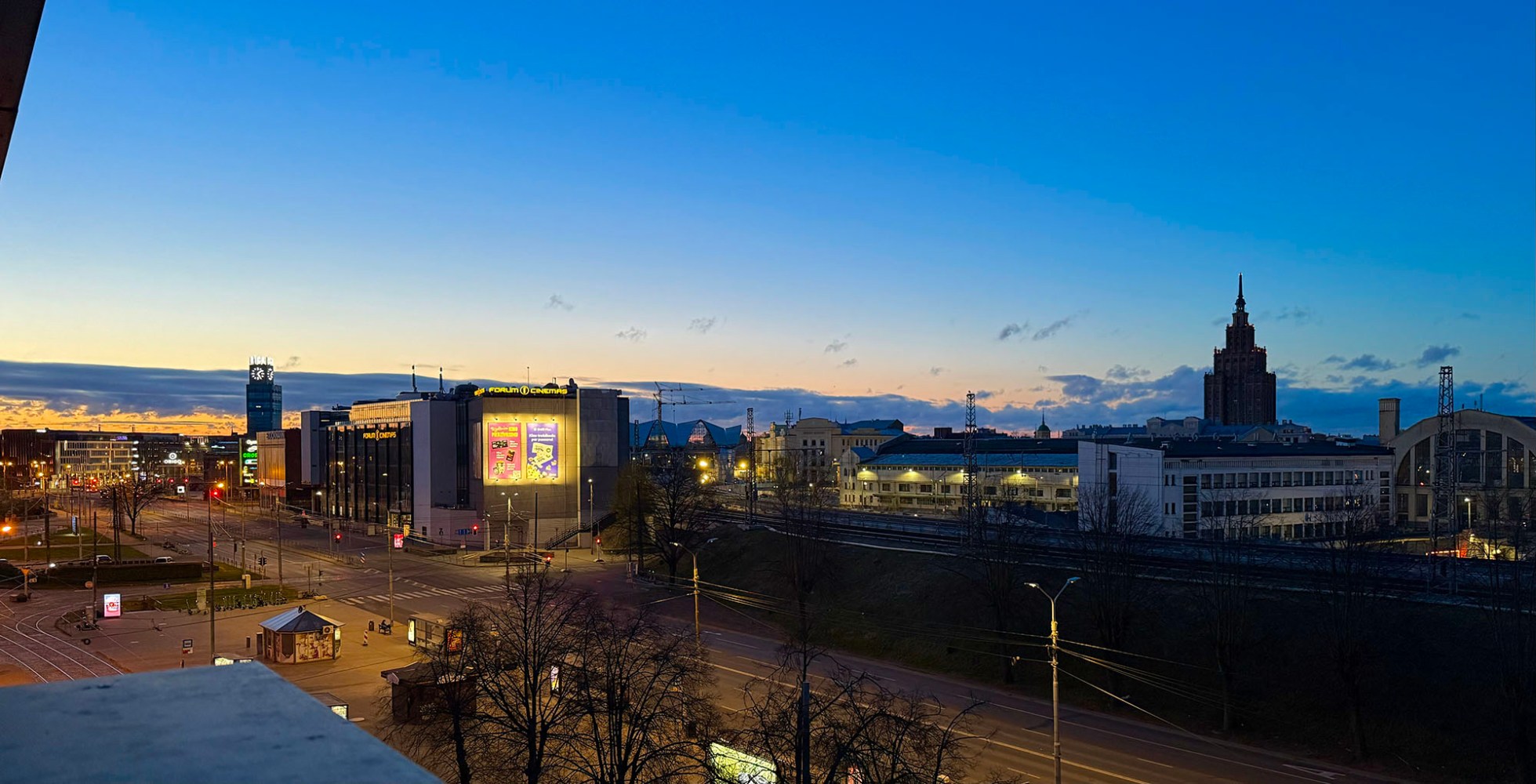
On the plus side, I did get to see a pretty sunrise.
The video
Below is one of my taster videos for the encuentro.:
There’s also a short clip from the official Facebook group in which I make a brief appearance:
Heartfelt thanks
Many thanks to Indra and Guntis for hosting; Felicia for suggesting it; Sheila and Andy for tales of hockey teams and being a bad influence on Sunday night; all of the DJs for a non-stop stream of delicious music; (almost) all the leaders for the superb floorcraft; and all my followers for wonderful dances. (No thanks to BA for the early starts and unwanted sightseeing excursions to Helsinki Airport.)
I said at the beginning that I was walking into a roomful of strangers, but next time it’ll feel like walking into a roomful of friends.

