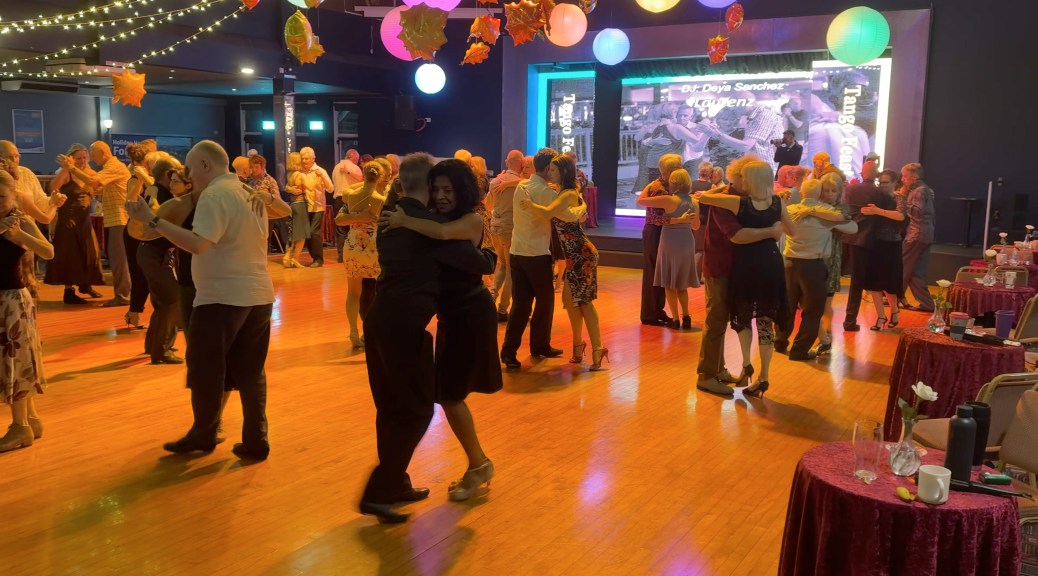
It’s a testament to the Feast that I no longer write blog posts about it. It seems odd to see the mix of wonderful music, fantastic followers and beautiful atmosphere as just business as usual, but that’s the case.
In theory this means that I get to spend the train ride home staring out of the window instead of at my laptop. However, while I didn’t imagine that having a private with Mabel was going to lead to me writing a thesis about the cross, here we are …
Watching the end of the Leading Ladies workshop
I do have quite strong preferences about where I like to sit in the room, with proximity to the tea station a key factor (I’m almost entirely powered by tea). For this reason, I like to get there before the start of each milonga, and a couple of times this meant catching the end of the Leading Ladies workshop, which was on the ocho cortado. It was eye-opening.
Every one of the participants will have followed the ocho cortado a million times, and can do so in their sleep. Despite this, learning to lead one didn’t look any different at all to the memories of my first beginner classes. There were exactly the same pauses to figure out which foot to be on to begin the movement, where and when to change weight, and when to dissociate and re-associate. I almost broke out in a sweat at the memory of those times!
As a leader, you start out by learning figures like the ocho cortado. At some point, you move past the standard steps and develop an understanding of that family of movements. It’s rare that I lead the classic steps for an ocho cortado, but what I’m leading is based on the underlying principle. For followers, it’s the same thing – as soon as they actually learn to follow, then they have no need to remember any of the steps they learned as beginners: they instead pay attention to how the leader is moving and execute whatever step, pivot, dissociation or reassociation is needed to stay in front of them.
That’s the mental challenge as a leader learning to follow. I have to forget any theory about what my leader might be leading, any thoughts about how they might interpret this moment in the music, any expectations about type of movement, direction, size or pace. I have to completely switch off my leader brain and instead ‘just’ listen to the follower.
In one way, this should be simple. Leaders also have to listen to their follower, whether that’s as simple as waiting until they have fully transferred their weight before leading the next step or following the follower in collaborative dance. Yet somehow I feel like a less sensitive listener when following. My theory is that this is about tension: I’m relaxed when leading; I’m still figuring out how to relax when following.
In the case of crosses, there’s an additional factor …
The cross is the most complex movement in tango
In my view: the cross – although taught in complete beginner classes – is actually the most complex movement in tango. I’ve written about this before, when describing a lunchtime conversation with a teacher in BsAs, and quoted it in my post about my previous lesson with Mabel.
Those differing ideas about how to lead a cross likely propagate through different teachers, and so on any dance floor there will be leaders who have been taught very different theories about it, and given very different guidance about how to lead one. Followers need to be able to pick up on what are actually extremely variable signals.
Even as a very early-stage beginner follower who has previously insisted I can only follow steps and rebounds, I’ve had enough leaders determined to prove me wrong that I’ve already got to experience that variety of approach for myself.
A private with Mabel on following crosses
One element of leader privilege is very much still evident. I said one time:
Booking a place at the Feast is always a three-step process for me: register, buy train ticket, book private with Mabel.
I can do this because I get a confirmed place right away; I found a number of followers who wanted one but found all the slots were gone by the time their registration was confirmed.
I’d already warned Mabel about the challenge she was going to face! While I have occasionally done something that might be mistaken for following a cross if you have particularly poor eyesight, I do have one or two finer technique points to master. Things like reading the signal for a cross at the time it’s led rather than gradually developing a theory about what I was supposed to have followed some five or ten seconds later.
Fortunately, Mabel relishes challenges. As always, we started by dancing a song so she could calibrate my existing level of competence, and as soon as we’d both been given the all-clear by the paramedics were able to get to work.
We started with the fundamentals. The theory of following is simple: my job is to stay in front of the leader’s chest. If our chests are facing, then whether flat or dissociated, there’s no call to cross. But if the leader’s chest either turns (reassociating in parallel system) or moves sideways away from me (shifting track in cross system), then I need to remain with their chest, and the cross is the simplest way to do so.
Before we could get to that, however, we needed to work on the more basic technique of how to maintain forward intention toward the leader while walking backwards. The usual way of explaining this is to talk of a diagonal vector, with some degree of apilado. Mabel’s more specific advice to me was to imagine a point somewhere above the leader’s head, and to then imagine a line through my own body intersecting this. That’s a really great metaphor as it incorporates not just the forward intention but also an upward rather than downward one (every leader knows how uncomfortable it is when a follower hangs on you).
We then worked on the technique for the cross itself, the most fundamental aspect of which is pivoting on both feet for as long as possible. Only after doing that do I push off with the forward foot while bending the knee of the now-free leg in order to allow it to pass the standing leg into the crossed position.
This immediately reduced the panic factor significantly, because most of the work is done while stable on both feet, and the cross itself is just the last 25% of the movement.
Another issue I’d had is around detecting the lead for a change of weight or not after the cross. I know from the leader side that it’s slightly frustrating if a follower does an auto-weight-change, expecting to walk out of the cross, when I may want to lead another exit that requires them to remain on the same leg, so I was keen to ensure I didn’t do this. (For the avoidance of doubt, it’s exceedingly rare to find a follower at the Feast who does that, but it’s not uncommon in some places.)
But actually, the ‘pivot on both feet for as long as possible’ approach solved this one too! It removed the feeling of rushing from the cross, and that in turn meant I felt very stable on the standing leg and could happily leave my weight there. When Mabel did lead a walk out of the cross, both changing weight and stepping could comfortably be done on the same beat; I’d previously been viewing these as separate things.
I saw how collaborative dance could work here from the follower side. If the leader is leading a slow cross, then this stability gives me the option of varying the pace.
Mabel also helped me understand the difference in feel when a leader was leading a shallow cross versus a deep one, and made a valiant effort to persuade me that I might be able to follow a back-cross too! I had to advise that my brain was full and we’d tackle that one next time.
As always with Mabel, it was a fantastic lesson. Of course, understanding the technique and employing it are two very different things, but I really feel like a lightbulb switched on in terms of how to cross. A few dual-role dancers were kind enough to give me some practice, and while it’s still all very clunky and unreliable, all of the panic about the movement itself is gone and I feel like it’s now just a question of practice.
If any dual-role dancer in London wants to practice leading crosses, please get in touch!
Three impacts on my lead
Almost every lesson I’ve had as a leader, I’ve asked the teacher to lead me so that I understand how it’s supposed to feel to the follower. I started doing this from, I think, my third or fourth lesson. At that point, my aim wasn’t to be able to follow, just to better understand the lead.
Now that I’m learning to follow, the same thing remains true. Every lesson I have as a follower, something will also click as a leader. That absolutely happened this time, only … not initially in a good way!
When I lead a cross, I do it instinctively, not consciously thinking about the technique, the depth or anything else – we just end up where I’d intended. But after the lesson with Mabel, the inside of my head looked like this:
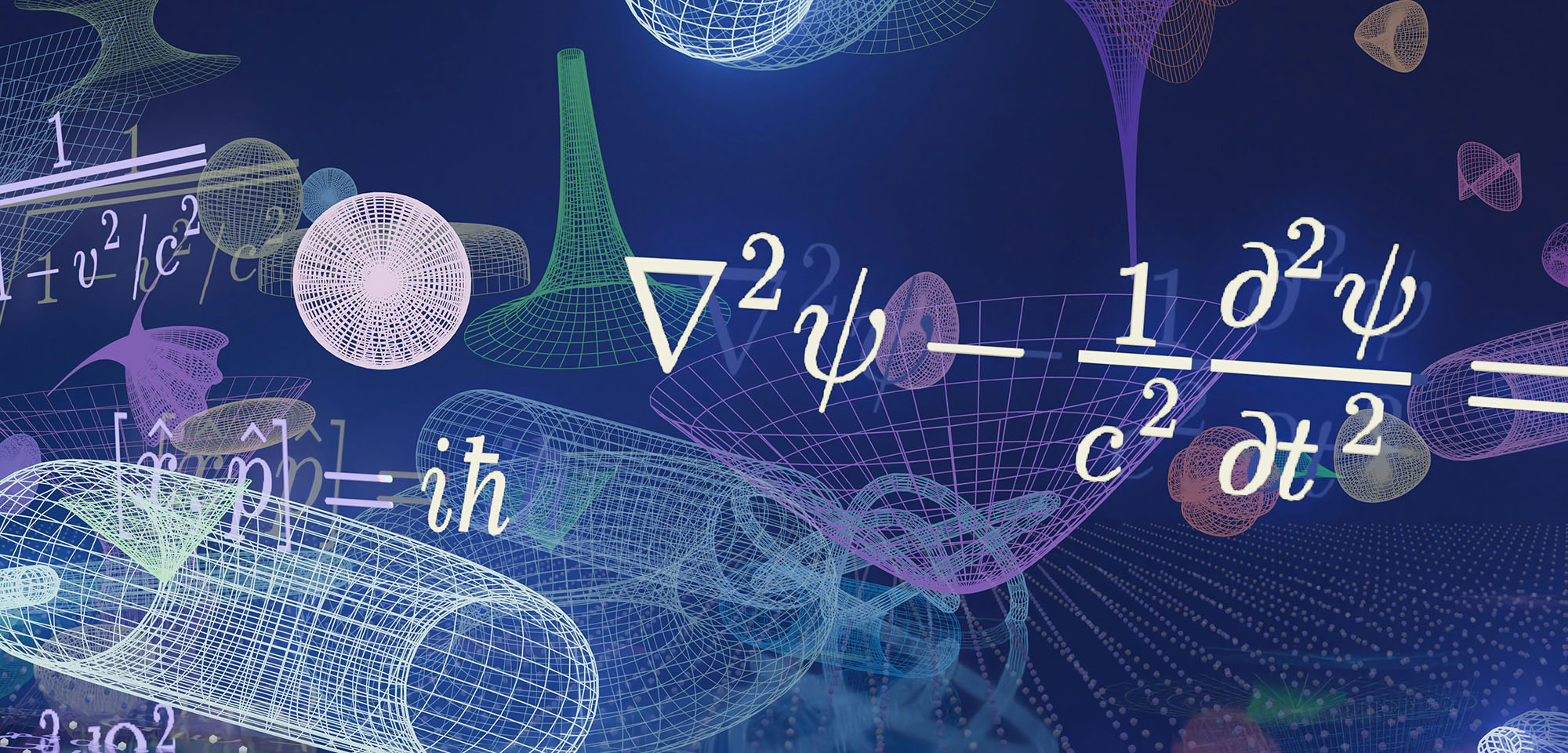
The immediate result was that, for about the next three tandas, I could barely lead a cross! My head was too busy thinking about what I was leading instead of letting my body just get on with it. Fortunately, that effect was temporary!
Second, I started feeling like I was conscious of the two phases when my follower crossed – the double-weighted pivot followed by the cross. I can’t say for sure that it made any discernible difference to my followers in terms of how my lead felt, but certainly for my part I felt it had boosted my sensitivity – and that was a lovely feeling either way.
Third – and this one truly is a miracle – I found I was able to comfortably lead crosses in milonga! My milonga has always been as simple as can be: mostly stepping on the beat, a little double-time stuff here and there in the form of interrupted steps, and that’s it. A cross at those speeds had felt beyond ambitious, yet now I felt like it would be possible.
I danced the first song in a milonga tanda with a follower then asked her if it would be ok if I experimented with something. I warned her it might feel clunky, and assured her I’d abandon the experiment reasonably promptly if there were any fatalities. Having been told to go for it, I did – and after perhaps two or three clunky ones, I got the feel and it was suddenly working smoothly and easily. Indeed, I found myself wondering why I’d ever thought it would be difficult. I was a cross machine for the remainder of the milonga tandas I danced.
There was just one more miracle, this one occurring on Saturday night …
Non-grumpiness at a performance
There are vague rumours that I have, on occasion, been known to observe that, on balance, I would have a mild preference for milongas to be largely uninterrupted by performances. There are three reasons for this.
First, the simple loss of time on the dance floor. By the time the performance has been announced, the performers have told the DJ at the last second which version of the songs they want, and all of the nonsense where the dancers pretend it’s one or two songs and walk off and everyone has to do the clappy stompy thing before they reluctantly return for another song or two or three … then half an hour or more of dance time is lost.
Second, the flow of the evening is interrupted. Everyone who was fully warmed-up beforehand now has to get back into the groove. It can take time before the feeling on the dance floor returns to the way it was.
Third, there are the inevitable wannabe performers who feel it should have been them everyone was watching, and they now attempt to emulate very badly whatever it was they’ve just seen, with consequent impact on the floorcraft. Sometimes it literally never returns to the way it was before.
(If you’ve seen me videoing performances, that’s usually just because it gives me something to do.)
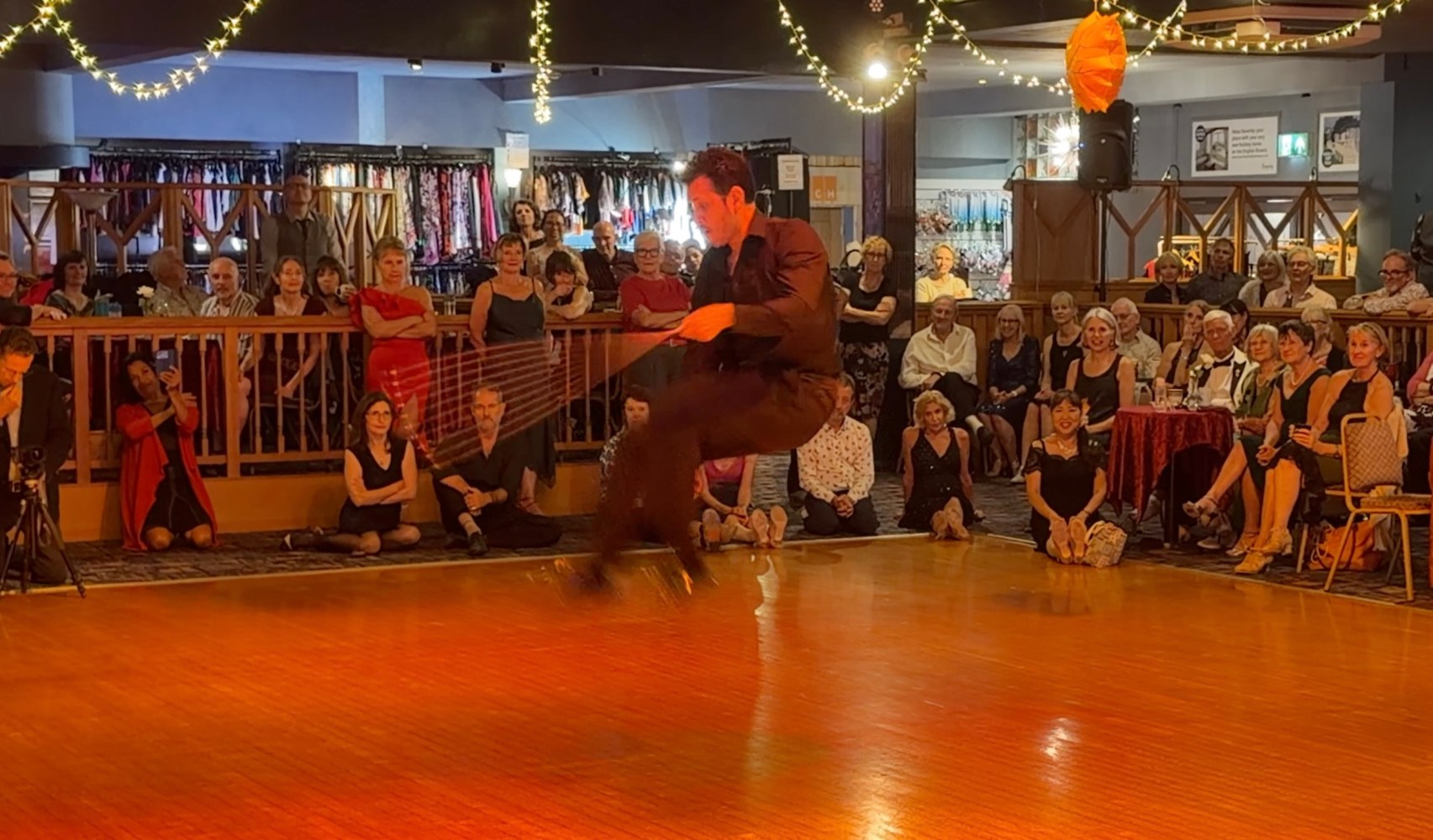
But occasionally there are exceptions, and the folk dance performances by Giusy Santoro and Diego Ledesma were certainly one of them! After a vals and a tango, Diego introduced me to a folk dance using boleadoras – weighted ropes once used to catch cattle by tangling their legs. That was truly spectacular:
The two of them then danced an absolutely beautiful zamba:
Finally, they took the folk dance usually mangled by Argentines and foreigners alike as a bit of harmless fun – Chacarera – and demonstrated that it can be stunning:
(Sure enough, the rest of us had the usual incompetent fun later in the weekend!)
This was one set no-one on the floor would be trying to copy!
Until December
As always with the Feast, on Thursday evening it feels like there’s an endless array of dancing ahead of us, and then half an hour later it’s somehow midnight on Sunday night.
I said a year ago that it had been the best Feast ever. The same was true of the one after that. And again the next time. And yep, yet again this time. I have no idea how it’s possible for them to get better and better, and yet somehow they do.
Tango dancers are a strange species: we’ve just spent four days hugging each other on the floor, but we then require at least another half an hour of farewell hugs before we can actually leave the room. Fortunately there’s not too long to wait until we can re-enter it.

