I will talk about Dante Culcuy’s práctica, I promise, but it’ll take me a while to get there. Experienced readers of my blog know it’s often advisable to make a cup of tea before reading, and that is absolutely the case with this one.
My early tango journey was unusual in many respects. I’d never danced before in my life (barring four Ceroc lessons immediately prior, as a kind of gentle intro to dance). I started with privates before group lessons. I began dancing in milongas within weeks rather than months. I was introduced to collaborative dance just four months in. I made my first pilgrimage to BsAs as a one-year beginner. Oh, and I started a tango blog …
A weakness that became a strength
There was another difference. For a lot of leaders, progress in tango was initially measured in figures and sequences. In my first couple of months, this idea made sense to me too – that I would gradually tick off the figures I could lead. However, I quickly discovered what felt like a massive weakness at the time but actually turned out to be a huge strength.
I have pretty much zero step memory. I’m simply not capable of separating steps from the technique needed to lead them, so I can’t do the rote ‘just repeat the steps a zillion times without worrying about actually leading them’ thing. Since I have to simultaneously worry about the steps and the technique, then my tango brain maxes out at about two steps – maybe three on a good day.
A number of leaders with decades of experience later told me how fortunate I’d been in both this and my early BsAs experience. They said many leaders spend years and years focused on steps, figures and sequences before eventually discovering these are the least important things in tango – and some never escape that stage.
I was saved from that fate by a combination of not being able to memorise a sequence to save my life, and BsAs teaching me what really matters in the dance.
That put my focus firmly on the fundamentals: the quality of my embrace, the connection with my partner, the interpretation of the music, floorcraft and … walking! Variety in my dance didn’t mean vocabulary, but rather varying step size, speed, degree of pivot, acceleration, deceleration and more.
A strength that became a weakness
I’d had compliments on my musicality almost from the start. That’s partly because music has always been a really important part of my life, and partly because I rapidly found myself listening to almost nothing but tango.
For a very long time, I found that a small vocabulary coupled to a lot of dynamic range was all I needed to express the music. But while doing so via the ‘how’ rather than the ‘what’ could get me a very long way with lyrical music, I finally found I was also developing a taste for the type of rhythmic music I’d previously dismissed. And in that, the gap between what my ears heard and what my body could express was far greater. For that, I finally felt I needed to understand more possibilities for types of movement.
Not, I hasten to add, sequences. What I’m seeking now is to give my body more examples of all the different ways in which it can move.
It struck me that an obvious way to do this was to revisit all those figures covered in early group classes that I’d long since allowed to fall out of my brain. That is, after all, the true point of them: not for leaders to execute a bunch of them in succession, but rather to use them as a basis for teaching our bodies what is possible so we can improvise more extensively. Once the ‘aha!’ moments occur from each, the figures themselves can again be discarded.
The search for a práctica
Since I didn’t want to be trying a bunch of ‘new’ things with unsuspecting partners on the dance floor, I last year went in search of a práctica.
This is something that’s harder than it sounds in London. Back in my very early days, I found that a couple of events that called themselves prácticas were really just casual milongas – so much so that I ended up holding my own at home. Saturday afternoons saw a bunch of my beginner friends and me trying to tell left from right with varying degrees of success.
The good news this time around was that I found not just one but two lovely ones: Sumate and the Tango Secrets practica. The bad news was that they were both on a Monday night. Despite my initial enthusiasm, I quickly discovered that starting the week with a late night wasn’t a great plan.
Life then got rather busy on other fronts, and I’m now picking up where I left off. Fortunately, Tina was able to recommend a practica that isn’t on a Monday.
Dante Culcuy’s practica
Dante’s practica is on a Thursday evening, which is a far more civilised proposition. It’s also on a direct tube line for me, so easy to get to despite being worryingly deep into west London – Shepherd’s Bush Market. With timings of 8pm to midnight, it offers four hours of practice for £12 (or £20 if you also want to take the one-hour intermediate class beforehand).
Dante describes the event as ‘a práctica party,’ and I think that’s a good description of the atmosphere. I walked in to find wine and snacks on the table, a chess set to one side for anyone who fancied a side-quest, a large studio with full-length floor-to-ceiling mirrors along one length, atmospheric lighting – and a friendly group of people.
On the ‘party’ side of the equation, the first week I went Dante had announced there would be a surprise at 10pm; this was to have been a visiting singer from Buenos Aires. He didn’t make it, but it turned out we had a beautiful singer among the dancers, Anastassia Szegal!
I think there were around 15 to 20 people there the first time, and maybe 30 the following week, which was certainly more than enough to practice with a range of partners. As an excellent bonus, one of them was a friend I hadn’t seen for a long time and hadn’t danced with for even longer! It was really lovely to do so again.
With the atmospheric lighting and music played in tandas, it could be argued that it isn’t so different from the informal milongas I found before. However, I get the sense that most people are there to actively work on their dance, so it does feel different to me. In particular, I feel four freedoms I wouldn’t feel in a milonga or a milonga dressed as a practica:
- Letting a follower know I’m likely to do the same thing over and over again for a couple of songs
- Warning her when I’m at an early stage of working on something that might feel rather rough-and-ready
- Asking a friend to video a whole song so that I can analyse it afterwards
- Asking for feedback
There’s also a small second studio with brighter lighting, suitable for stopping and starting and having discussions without disturbing other people.
Finally, and crucially, a key element of a true practica for me is a teacher available to provide input. I asked Dante to watch me for one song while I worked on a particular movement where I knew what was missing from my lead but couldn’t figure out how to fix it, He immediately identified the solution and took us into the small studio to first explain and then let me lead him until I got it. Both myself and my partner could immediately feel the difference, and while it will take time to bed in, I now feel like I’m fully on track with it.
Me being me, I’ve created a colour-coded spreadsheet of all the movement elements and figures I’m working on, with a hierarchy from ‘Need a private lesson on this’ through to ‘a habitual part of my dance.’ Orange represents the ones I want to practice, while yellow is used once I think I’ve got the hang of something and followers at the práctica are happy with it – but where I want to check with a teacher before I consider it fully milonga-ready.
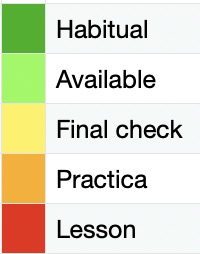
I’ve so far been choosing two main ones to work on each week, and I’m currently estimating it will take me two or three sessions with each to turn an orange element yellow. Once a teacher signs off my technique as up to scratch, I’ll choose one or two elements to consciously incorporate into each milonga until my body gets the idea and I can once more throw away the figure.
Additionally, I’m aiming to get at least a little practice each week at following the cross, so I’m also viewing the práctica as a way to increase the pace of my progress as a follower from ‘static’ to ‘glacial.’
If you’re tempted to join the party, you can find all the details here.

